


Attributing a cyberattack: the method, and why it is disputed
APT29, Cozy Bear, Midnight Blizzard: three of the five names one group carries. What technical evidence can establish, what it cannot prove, and who decides.
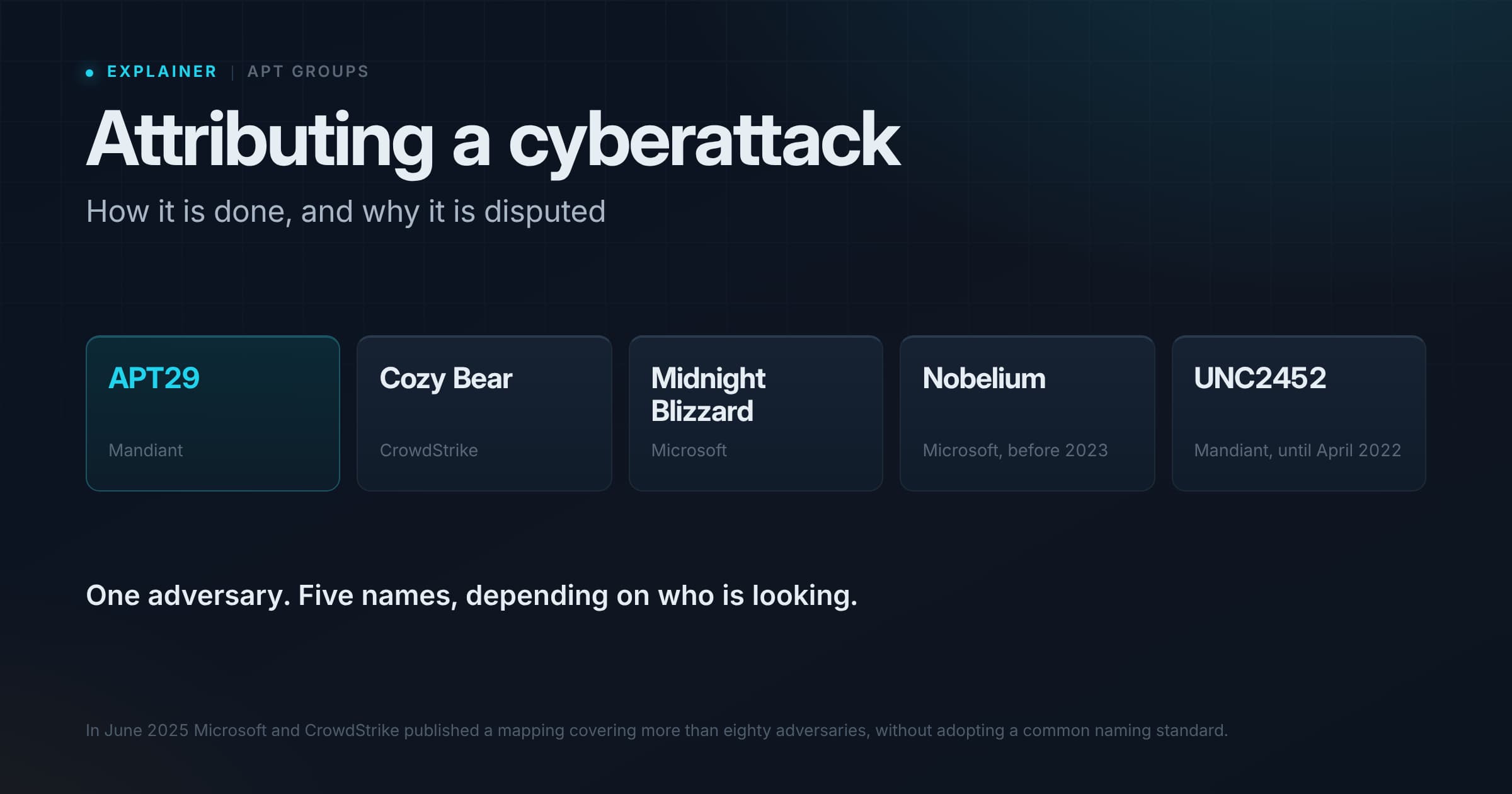
The same adversary is called APT29 at Mandiant, Cozy Bear at CrowdStrike, Midnight Blizzard at Microsoft, and Nobelium at the same Microsoft before 2023.
On 2 June 2025, Microsoft and CrowdStrike released a mapping between their respective naming systems covering more than eighty adversaries. Both companies were careful to say that the work creates no shared taxonomy: it simply aligns the labels each already uses1.
A fifth name dropped out along the way. Mandiant had tracked the activity found in the SolarWinds compromise as UNC2452 before folding it into APT29 on 27 April 2022, having gathered enough evidence to tie the two together2. An attribution, then, is not a verdict. It is a state of knowledge at a given date.
What is being attributed, and to whom
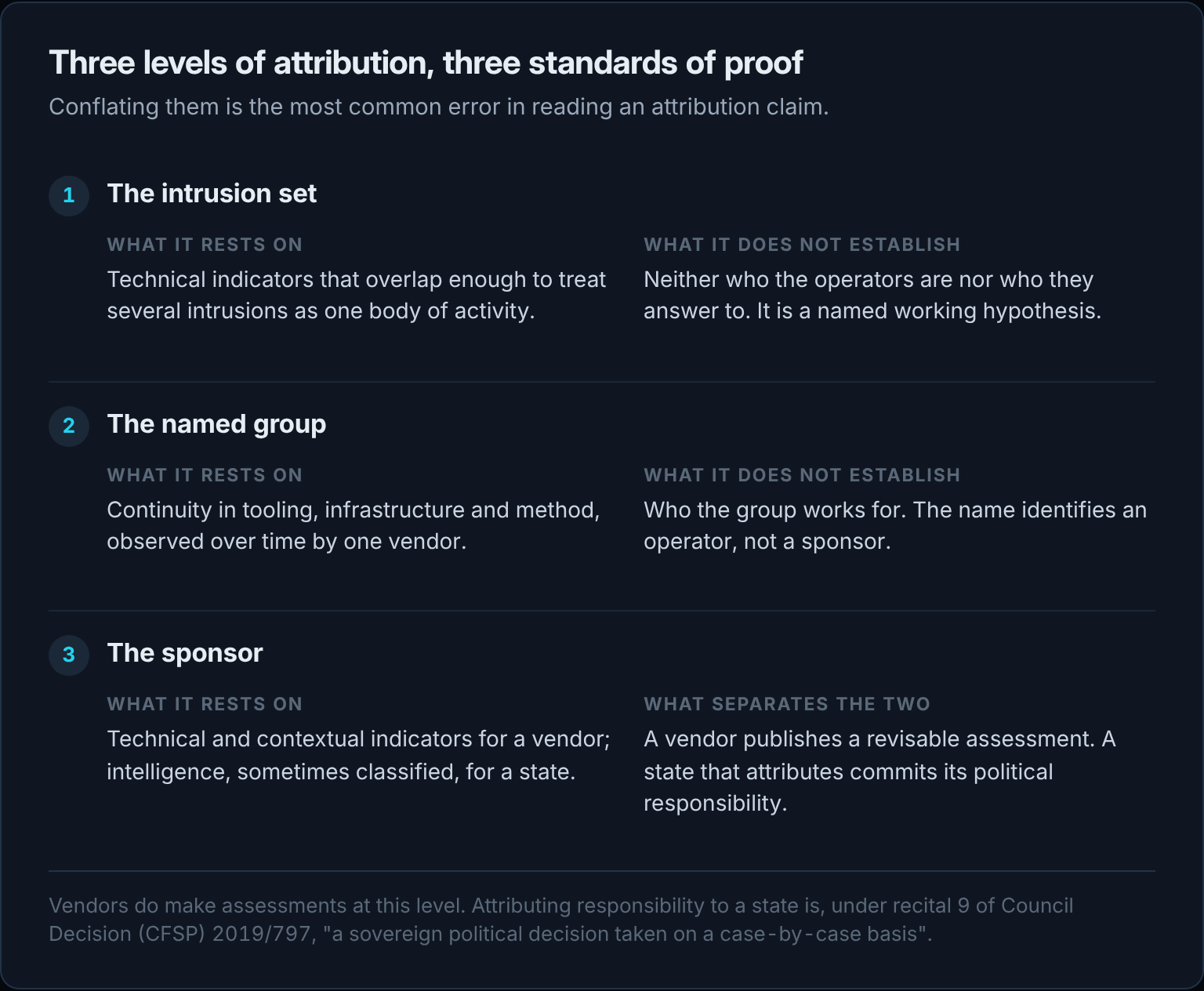
Three very different claims travel under the same word, and confusing them produces most of the misunderstanding.
The first is the intrusion set. An analyst finds that several incidents share enough technical overlap to be worked together, and gives them a provisional identifier: UNC2452 at Mandiant, where UNC stands for uncategorised. At this stage nobody claims to know who is operating.
The second is the named group. When an intrusion set shows sustained continuity in tooling, infrastructure and tradecraft, the vendor assigns it a stable name. This is a judgement about the coherence of an operational actor, not about its employer.
The third names the sponsor, and vendors go there regularly. In merging UNC2452 into APT29, Mandiant noted that its conclusion matched that of the US government, which ties the group to Russia's Foreign Intelligence Service (SVR)2. What separates that assessment from a state attribution is not the boldness of the conclusion but the nature of the act. A vendor publishes a judgement it will revise if the evidence changes. A state that publicly names another performs a diplomatic act, commits its own responsibility, and opens the way to sanctions or prosecutions.
The evidence, and what it carries
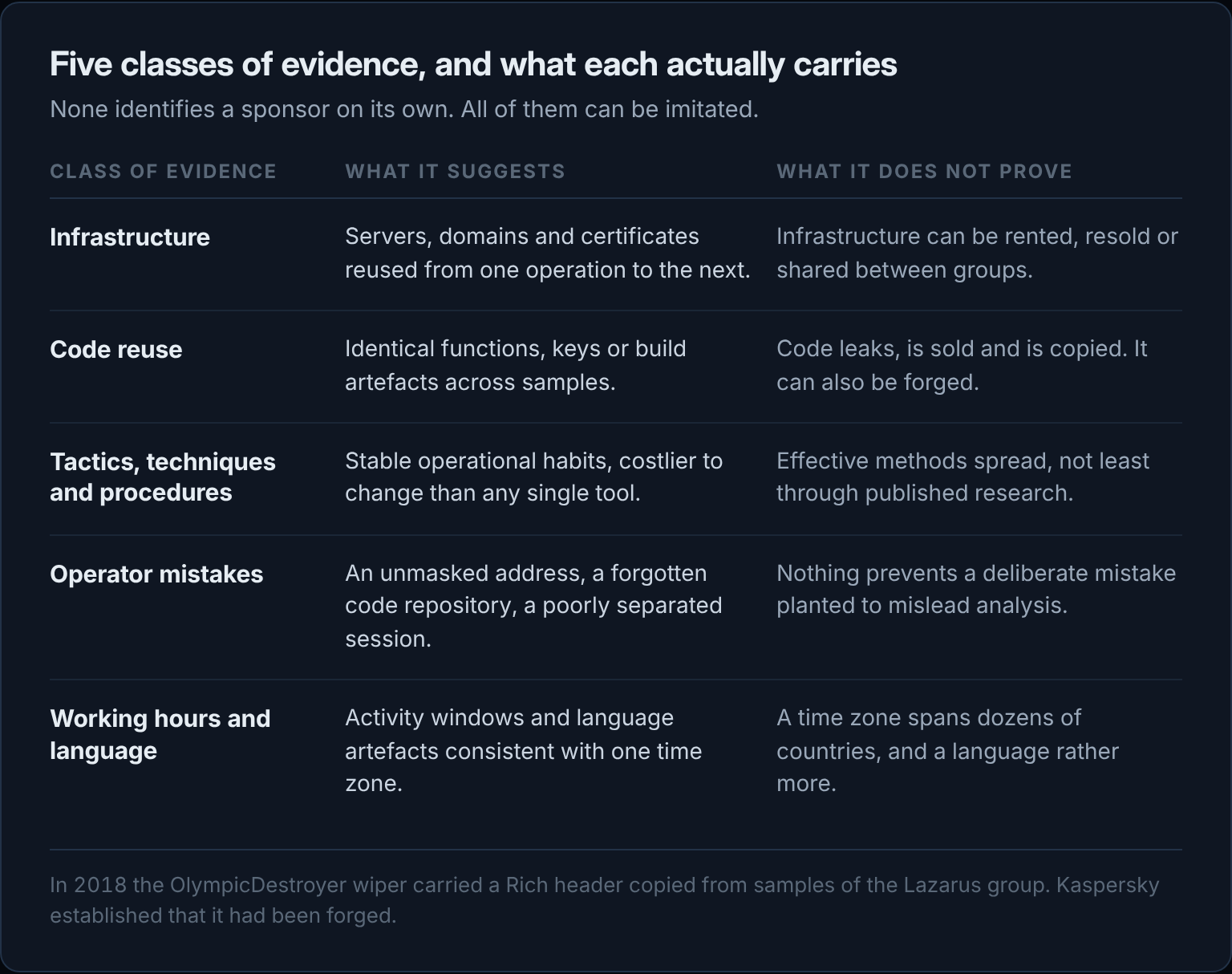
The technical work draws on five classes of indicator, none of which is sufficient alone.
Infrastructure comes first: command servers, domains, certificates and addresses reused from one operation to the next. It is the most accessible trace and the most fragile, since hosting is rented, resold and shared.
Code reuse follows: identical functions, shared encryption keys, artefacts left behind by the build toolchain. The argument is stronger, provided the code has not leaked, which happens regularly.
Then come tactics, techniques and procedures — operational habits. These cost more to change than tooling: a team that has learned to move through a network a certain way keeps doing it. That is also why they spread, partly because public reporting describes them.
Operator mistakes sometimes yield the most telling material: a connection made without anonymisation, a code repository left open, a poorly isolated test session.
Last come language artefacts and activity hours. They point a direction and rarely more: a time zone covers dozens of countries.
When an indicator is planted deliberately
The limit of this method comes down to one case, and it is documented from beginning to end.
On 9 February 2018, during the Pyeongchang Winter Olympics, a wiper named OlympicDestroyer hit the organisation's systems. The first samples analysed contained a Rich header identical to one found in samples from BlueNoroff, a unit of the North Korean Lazarus group. The Rich header is an undocumented structure that Microsoft's linker inserts into most executables; it describes the tools used to compile the file, rather like a bill of materials.
Kaspersky demonstrated that the fingerprint was false. The header described a build under Visual Studio 6, while the binary called a library that did not exist at that time; analysis of the startup code matched Visual Studio 2010, which would have produced an entirely different header. The researchers concluded that the structure had been intentionally copied from the BlueNoroff samples and bore no relation to the file's actual contents3.
The detail that settles the demonstration is almost domestic. One sample uploaded on 9 February, with its execution delay stripped out, carried a perfectly consistent Rich header. Compiled in a hurry, it had escaped the forgery: the operators forgot to fake that one.
What came next gives the episode its force. On 19 October 2020, the British government publicly attributed the attack to the GRU's Main Centre for Special Technologies, Unit 74455, also tracked as Sandworm. The statement says the unit attempted to disguise itself as North Korean and Chinese hackers in targeting the opening ceremony, and assesses that the intent was almost certainly sabotage4. The same day, the US Department of Justice announced charges against six officers of that unit, covering a set of operations including the destructive attack of 9 February 20185.
Two things follow. The false trail worked in the short term: it pushed early analysis towards North Korea. It did not survive two years, because the final attribution did not rest on a file header.
Confidence and probability do not measure the same thing
Serious assessments carry two markers that are easily conflated.
The first is probability: how likely the claim itself is held to be. The British statement on Pyeongchang offers an example when it judges the intent "almost certainly" sabotage4. In intelligence frameworks these terms map to numeric bands — "likely" covers roughly 55 to 80 per cent at the Center for Internet Security, which aligns its practice with the relevant US directives6.
The second is the confidence level: how solid the basis is, meaning the number, variety and reliability of the sources. High confidence does not turn an assessment into established fact6.
The two move independently. An analyst may judge a hypothesis very likely while holding only moderate confidence, because a single source supports it. The reverse happens too: numerous corroborating sources can underpin a cautious conclusion. Reading "high confidence" as "90 per cent certain" is the most common error, and it creeps into secondary reporting more often than into the original assessment.
These scales bind nobody. Public frameworks exist, but no vendor is required to follow one or to publish its own, so the same word can carry different standards from one report to the next.
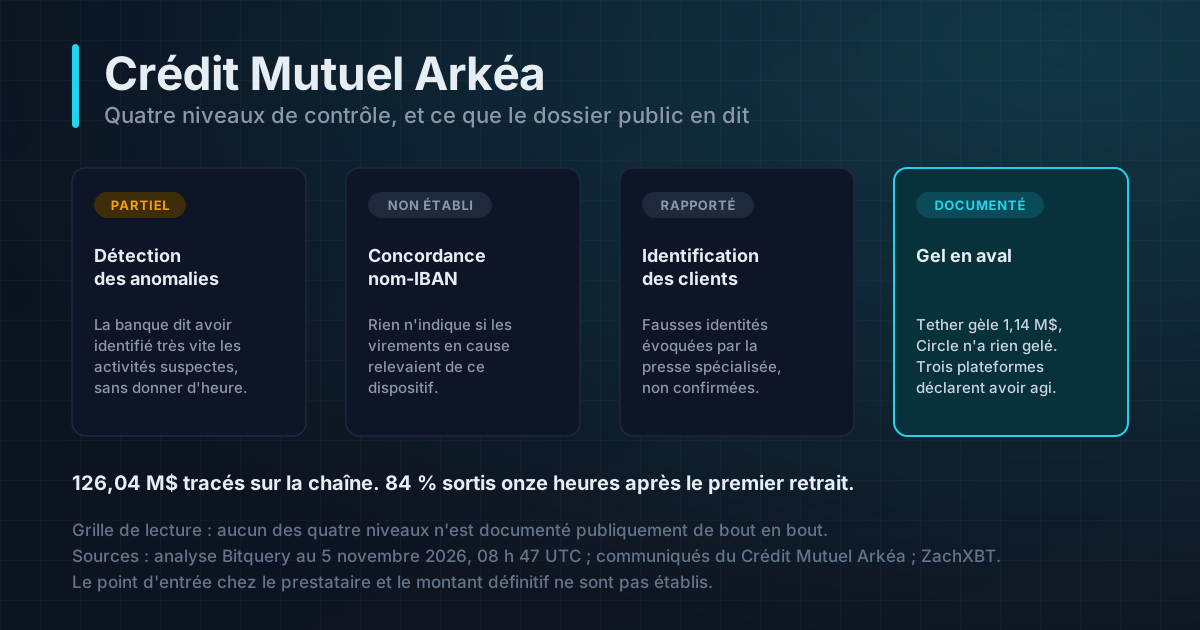
An attribution can also be negative. In the Crédit Mutuel Arkéa case, the investigator behind the initial report ruled out the Lazarus group on the grounds that the movement of funds did not match its habits. That reasoning is not the exact mirror of a positive attribution. Accumulating characteristic indicators strengthens a hypothesis; their absence weakens it without excluding it, since a group can change infrastructure, alter its methods or, as at Pyeongchang, deliberately borrow someone else's.
What a state commits when it attributes
The European sanctions regime for cyberattacks states the distinction explicitly.
Council Decision (CFSP) 2019/797 of 17 May 2019 establishes restrictive measures against those responsible for cyberattacks. Recital 9 provides that such measures should be differentiated from the attribution of responsibility for cyberattacks to a third state, that applying them does not amount to such attribution, which is a sovereign political decision taken on a case-by-case basis, and that each member state remains free to make its own determination7.
The reach of that text is the reach of a recital: it illuminates one sanctions instrument, it does not lay down a general rule of international law. It still says something useful. The Union can sanction people and entities without naming the state on whose behalf they were acting, and two member states can read the same material and reach different conclusions.
The silences follow from the same logic. A government holding solid material may choose to say nothing, because saying it would reveal how it knows, or because the moment is wrong. The absence of public attribution does not mean the absence of conviction.
How to read an attribution announcement
Four questions are enough to place what you have just read.
Who is speaking? A security vendor, a government, an independent researcher and a journalist hold neither the same data nor the same constraints.
What exactly is being claimed? An intrusion set, a named group or a sponsor. A headline that announces a state while the body of the text describes only a group has crossed a level without saying so.
On which classes of evidence, and with what confidence? An attribution resting only on shared infrastructure is weaker than one built on operational habits observed over several years.
Who corroborates it? A conclusion carried by three publications that all cite the same original source has not been confirmed three times. The same caution applies to attacker claims, which are reported far more often than they are verified.
For an organisation under attack, the question does not arise in these terms at all. The reporting obligations set out in NIS2 concern facts: what was observed, when, with what consequences. Naming a culprit is not among them, and attempting it in the first hours costs time without helping remediation.
One asymmetry remains that no method corrects. The attacker knows the truth and chooses what to leave behind; the analyst works on what was left. A solid attribution is still possible — Pyeongchang showed that — but it takes time, sources that technical analysis alone does not supply, and the discipline of stating what is known separately from what is inferred.
Sources & notes
-
CrowdStrike, "CrowdStrike and Microsoft Collaborate to Harmonize Cyber Threat Attribution", 2 June 2025, https://ir.crowdstrike.com/news-releases/news-release-details/crowdstrike-and-microsoft-collaborate-harmonize-cyber-threat ↩
-
Mandiant, "UNC2452 Merged into APT29", 27 April 2022, https://cloud.google.com/blog/topics/threat-intelligence/unc2452-merged-into-apt29 ↩ ↩2
-
Kaspersky, Securelist, "The devil's in the Rich header", 8 March 2018, https://securelist.com/the-devils-in-the-rich-header/84348/ ↩
-
Foreign, Commonwealth & Development Office and National Cyber Security Centre, "UK exposes series of Russian cyber attacks against Olympic and Paralympic Games", 19 October 2020, https://www.gov.uk/government/news/uk-exposes-series-of-russian-cyber-attacks-against-olympic-and-paralympic-games ↩ ↩2
-
United States Department of Justice, "Six Russian GRU Officers Charged in Connection with Worldwide Deployment of Destructive Malware and Other Disruptive Actions in Cyberspace", 19 October 2020, https://www.justice.gov/opa/pr/six-russian-gru-officers-charged-connection-worldwide-deployment-destructive-malware-and ↩
-
Center for Internet Security, "Words of Estimative Probability, Analytic Confidences, and Structured Analytic Techniques", https://www.cisecurity.org/ms-isac/services/words-of-estimative-probability-analytic-confidences-and-structured-analytic-techniques ↩ ↩2
-
Council of the European Union, "Council Decision (CFSP) 2019/797 of 17 May 2019 concerning restrictive measures against cyber-attacks threatening the Union or its Member States", recital 9, https://eur-lex.europa.eu/eli/dec/2019/797/oj ↩
Comments (0)
Leave a comment
Have an account? Sign in to comment with your account
No comments yet. Start the conversation!
Read next
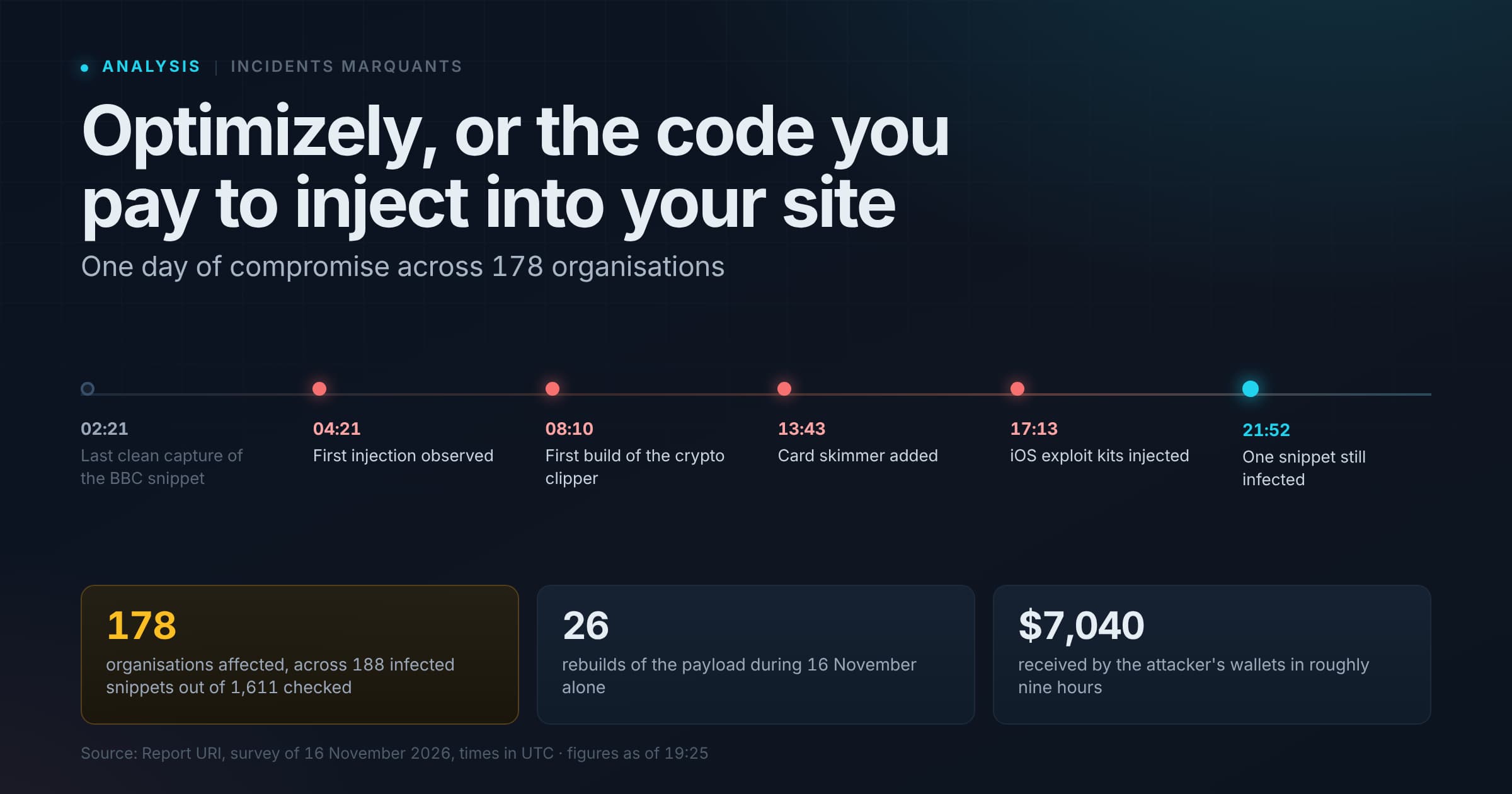
Optimizely: the code you pay to inject into your own site
178 organisations served a card skimmer through Optimizely. The attacker subverted nothing. He used exactly the function the platform exists to provide.
Crédit Mutuel Arkéa: what the controls could see
Four levels of control sit between a bank transfer and its conversion into crypto. In the Crédit Mutuel Arkéa case, only one produced a documented effect.