


Optimizely: the code you pay to inject into your own site
178 organisations served a card skimmer through Optimizely. The attacker subverted nothing. He used exactly the function the platform exists to provide.
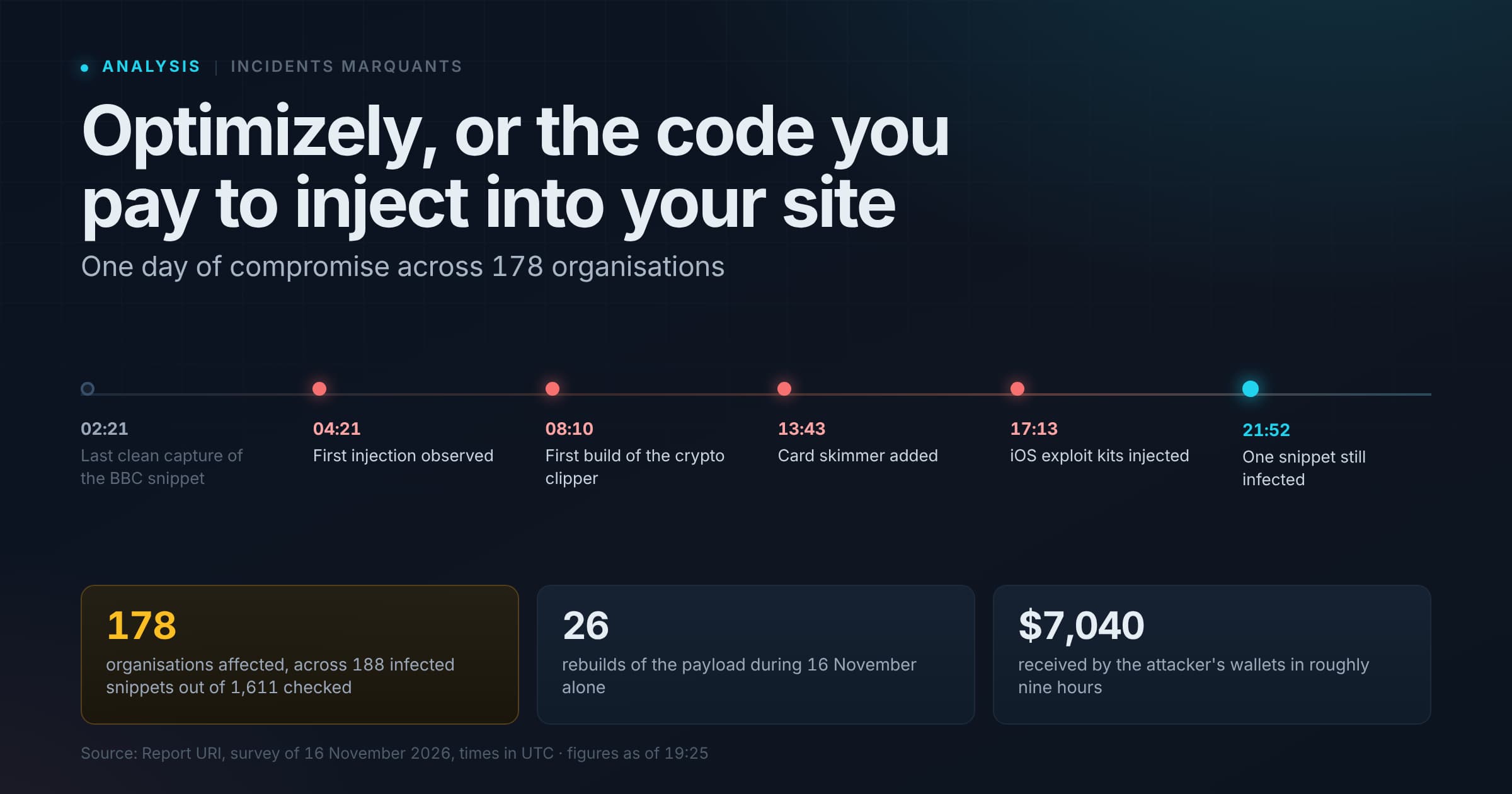
The field is called "Project JavaScript". It is an optional slot Optimizely provides so customers can place their own code, which is then served to every visitor of their site. That is where the attacker wrote the loader, on 16 November 2026, in the projects of at least 178 organisations1.
Everything else follows from that one line. The code left cdn.optimizely.com over HTTPS under a valid TLS certificate: to a browser, it arrived from the same trusted domain as Optimizely's legitimate scripts. A certificate attests to the identity of the server, not to the integrity of what it serves. Pages belonging to the BBC, CNN, Zoom, Salesforce, GitLab, IKEA, HSBC, Equifax, Air France-KLM and Ledger loaded it. Sites that self-host the snippet rather than loading it from the content delivery network were affected in the same way. The pages www.optimizely.com and login.optimizely.com served the code too1.
What the attacker used
Optimizely communicated in two stages. A status notice posted at 01:02 UTC on 17 November acknowledges the exploitation of a vulnerability in Experimentation and the addition of malicious JavaScript to some customer projects2. "We've fixed the vulnerability and removed the injected code from affected projects," the company writes there3. The notice says nothing about how the flaw worked, how many projects were affected, or when the fix was deployed2. The company then told BleepingComputer that the vulnerability lay in the service's account creation process, and set out its measures: tokens revoked, active sessions terminated, affected access reset, delivery of the malicious code blocked through Cloudflare, affected customers notified4.
That leaves the question nobody has yet addressed. How did a flaw in account creation grant write access to the projects of hundreds of unrelated customers? Report URI, which monitors third-party scripts and detected the campaign, wrote the day before that it had no idea: "That's for Optimizely to explain"1. It adds that the content delivery network was not cache-poisoned, and served exactly what it was given.
This is not the first intrusion the company has disclosed this year. On 25 February 2026, Optimizely confirmed unauthorised access to internal systems — Zendesk, records in its Salesforce CRM, a limited set of back-office documents — obtained through voice phishing, stating that the attacker had been unable to escalate privileges, install software or create a backdoor5. Nothing public connects the two episodes, and the systems involved are not the same.
What they do have in common is the nature of the product. A web experimentation platform exists to inject arbitrary code into other companies' pages, from a central console, under the vendor's domain name. That is its commercial purpose: testing a page variant without going through a deployment. The attacker therefore did not pervert the product's use, he made use of it. The shape of the problem matches a tool whose function is to act with privileges inside someone else's estate, one layer lower in the stack.
A campaign moving from provider to provider
The least discussed element of the affair is that Optimizely is not where it started.
The injector, hosted on a domain named webshell.lol, was first seen on 17 September 2026 on Turkish sites, distributed through the script of a backlink panel built for search engine optimisation. Between 13 and 16 November, the same injector was circulating through the Kissmetrics, StorifyMe and Minute Media scripts, reaching securitybank.com, faz.net, smh.com.au and foxsports.com among others. Optimizely came afterwards1.
Four third-party script providers in two months, for one injector. The public evidence establishes reuse of infrastructure, not a demonstrated targeting strategy; but the pattern is clear, and it falls on one category of supplier — those whose product consists of having their JavaScript executed by their customers' pages. Report URI stops short of naming an actor, which is the right restraint: a shared technical indicator establishes continuity of tooling, not identity.
Four malicious functions, uneven protection
The payload was rebuilt twenty-six times during 16 November alone, the attacker adding wallets and never removing any1.
The first component, assembled at 08:10 UTC, is a crypto address clipper. It replaces valid wallet addresses in the page text, in forms, in the clipboard, in outgoing requests and in the iOS share sheet. Anyone copying an address from an affected tab may paste the attacker's. The card skimmer arrived at 13:43, and the iOS exploit kits at 17:13.
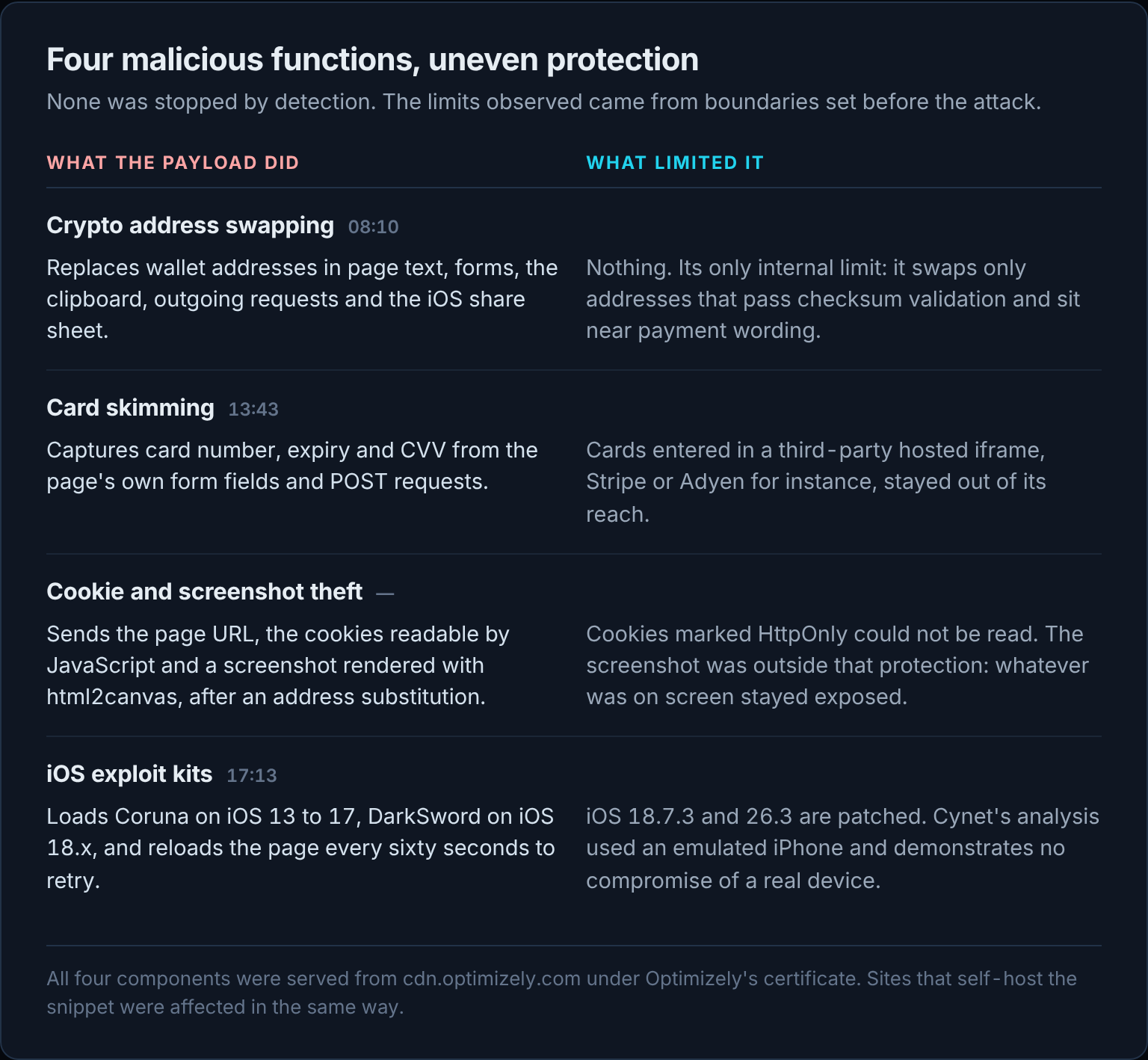
The limits observed deserve a close look, because none of them came from detection. The skimmer read the page's own form fields; cards entered in an iframe hosted by Stripe or Adyen stayed out of reach. Cookie theft, which fired only after an address substitution near payment wording and so did not affect every visitor, ran into the HttpOnly attribute: the payload sent the contents of document.cookie, meaning only those cookies readable by the page's JavaScript. The same request, however, carried a screenshot rendered with the html2canvas library, which HttpOnly does nothing to prevent. Whatever the page was displaying at that moment stayed exposed1.
As for the iOS kits, Cynet's analysis was performed against an emulated iPhone and the firm says it demonstrates no compromise of a real device; researchers note, from comments in the analysed code, that iOS 18.7.3 and 26.3 are not targeted2.
What contained part of the damage, then, was a set of boundaries drawn years earlier for other reasons. They worked exactly as designed, each within its own scope, and none neutralised the whole apparatus.
Allowlisting the vendor's domain protected nothing
Report URI crawled the hosts of 256 affected organisations. The published results detail four categories totalling 159 hosts; the remaining 97 are not accounted for1.
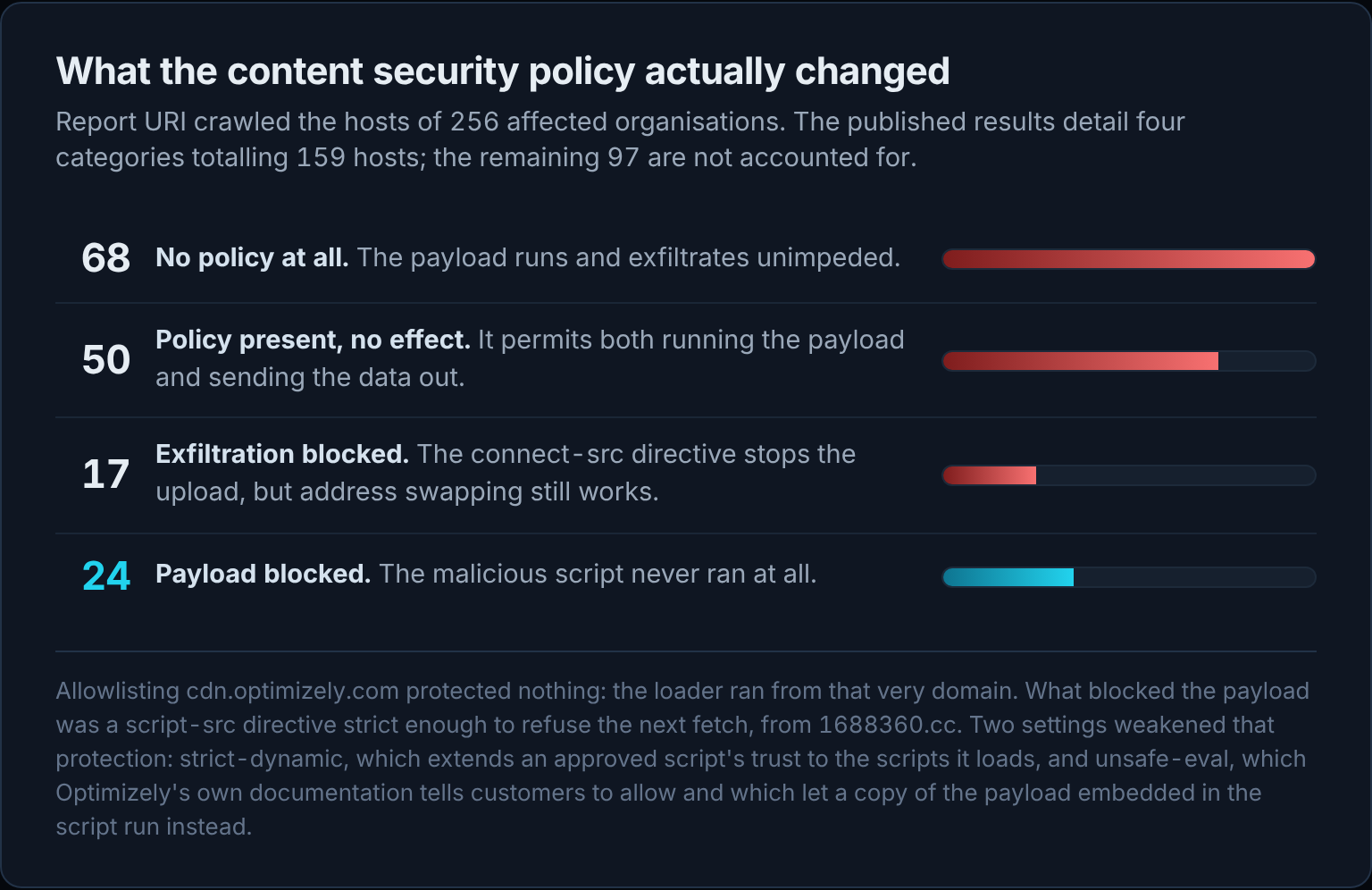
Sixty-eight hosts had no content security policy (CSP) at all, the mechanism by which a site tells the browser which origins it accepts code from. Fifty had one that permitted both running the payload and sending the data out. Seventeen blocked exfiltration through the connect-src directive without preventing execution, so address swapping kept working locally. Twenty-four, or 15% of the detailed cases, blocked the payload1.
Understanding why means separating two hops. The loader written into the Project JavaScript field executed from cdn.optimizely.com; no policy allowing that domain could stop it, since that is precisely what it declared trusted. But the loader then fetched the payload from 1688360.cc, and it is that second hop which a sufficiently strict script-src directive refused.
Two common settings weakened that protection. strict-dynamic extends the trust granted to a script, through a nonce or a hash, to the scripts that script loads in turn: the approved loader could therefore introduce its own. And unsafe-eval opened a second route, one the payload carried with it — a full copy of itself, in clear text inside the script, passed to eval when the download from 1688360.cc failed. Report URI places that case at HSBC, whose policy blocked both the remote script and the exfiltration, and notes that Optimizely's own documentation tells customers to allow unsafe-eval1.
That point is worth isolating, because it describes an ordinary situation: the configuration the vendor recommends in order to make its product work opened the route the rest of the policy was busy closing. Listing cdn.optimizely.com among trusted origins "was never going to help", Report URI writes. What does help is a policy narrow enough to refuse an unknown domain at the second fetch, without unsafe-eval, together with connect-src for where data may go. Which is to say a policy that departs from what the product's documentation recommends.
Seven thousand dollars
By 19:25 UTC on 16 November, the attacker's wallets had received about $7,040, accumulated over roughly nine hours, including some 0.083 bitcoin unspent at that time. Funds were already moving out to exchanges between 13:03 and 13:051. SOCRadar, recalculating the following day, arrives at close to $7,150: the amounts are in cryptocurrency, and their conversion depends on when it is done6.
These transactions give a partial view of the money moving through the attacker's addresses. They measure neither this campaign's proceeds nor the harm done. Report URI sets out both limits itself: the TRON wallet had been in use since March 2026, so not everything passing through it belongs to these twenty-four hours — reading an amount on the chain does not tell you where it came from — and nobody knows how many card numbers and cookies reached the collection server1.
What remains is the ratio that explains the choice of target: compromising a supplier whose code runs on hundreds of sites takes the same effort as compromising one site.
On 17 November, several parts of the infrastructure were taken down. The payload and collection domain 1688360.cc was placed on clientHold by its registry and stopped resolving at 00:37 UTC; webshell.lol, the injector domain of the earlier waves, followed at 03:37. Between 04:11 and 05:39, the attacker emptied the wallets, moving litecoin, USDT and bitcoin to new addresses. Other parts remained in place: SOCRadar notes that one of the iOS-related domains no longer resolves, while another still resolves but no longer responds6.
What a site can do
Report URI's recommendations are short and verifiable: search the code fields of Optimizely projects for the string atob( and for any unknown script; revoke and rotate platform credentials; deploy a restrictive content security policy, starting in report-only mode to measure before blocking1. The string 1688360.cc is worth searching for as well: it will not find the encoded variants, but it will find the others.
One methodological caution belongs with that list. A clean snippet today proves nothing about its state on 16 November: snippets were cleaned through the day, and some were reinfected. Verification has to work from logs and historical versions, within a window SOCRadar places between 13 and 17 November6.
The rest is a matter of architecture, and the question arises before the next incident rather than during it. Do the card entry fields belong to an iframe hosted by the payment provider, or to the page? Do session cookies carry the HttpOnly attribute? And how many third-party scripts does the payment page actually load, given that each one holds the same rights as the site's own code?
One detail in the timeline sums the problem up better than an argument. Smartsheet's snippet was cleaned, then reinfected with a variant of the loader hidden in base64. The attacker still had access while his code was being erased.
Position as at 17 November 2026. Optimizely has published no detailed post-incident analysis, and the exact mechanism of access to customer projects remains unexplained.
Sources & notes
-
Report URI, "World's Largest Brands Infected With Malware Via Optimizely", 16 November 2026, https://blog.report-uri.com/worlds-largest-brands-infected-with-malware-via-optimizely/ ↩ ↩2 ↩3 ↩4 ↩5 ↩6 ↩7 ↩8 ↩9 ↩10 ↩11 ↩12
-
The Hacker News, "Hijacked Optimizely Scripts Served Card Skimmer and iOS Exploit Kits to CNN, BBC and Zoom Visitors", 17 November 2026, https://thehackernews.com/2026/11/hijacked-optimizely-scripts-served-card.html ↩ ↩2 ↩3
-
SecurityWeek, "Optimizely Vulnerability Exploited to Serve Malware on Major Websites", 17 November 2026, https://www.securityweek.com/optimizely-vulnerability-exploited-to-serve-malware-on-major-websites/ ↩
-
BleepingComputer, "Optimizely supply chain attack delivers malware to CNN, Fox News, BBC, Salesforce sites", 17 November 2026, https://www.bleepingcomputer.com/news/security/optimizely-supply-chain-attack-delivers-malware-to-cnn-fox-news-bbc-salesforce-sites/ ↩
-
SecurityWeek, "Ad Tech Company Optimizely Confirms Cyberattack", 25 February 2026, https://www.securityweek.com/ad-tech-company-optimizely-confirms-cyberattack/ ↩
-
SOCRadar, "Optimizely Attack Hits Zoom, BBC, CNN With Skimmer, iOS Kits", 17 November 2026, https://socradar.io/blog/optimizely-attack-hits-zoom-bbc-cnn-with-skimmer-ios-kits/ ↩ ↩2 ↩3
Comments (0)
Leave a comment
Have an account? Sign in to comment with your account
No comments yet. Start the conversation!
Read next
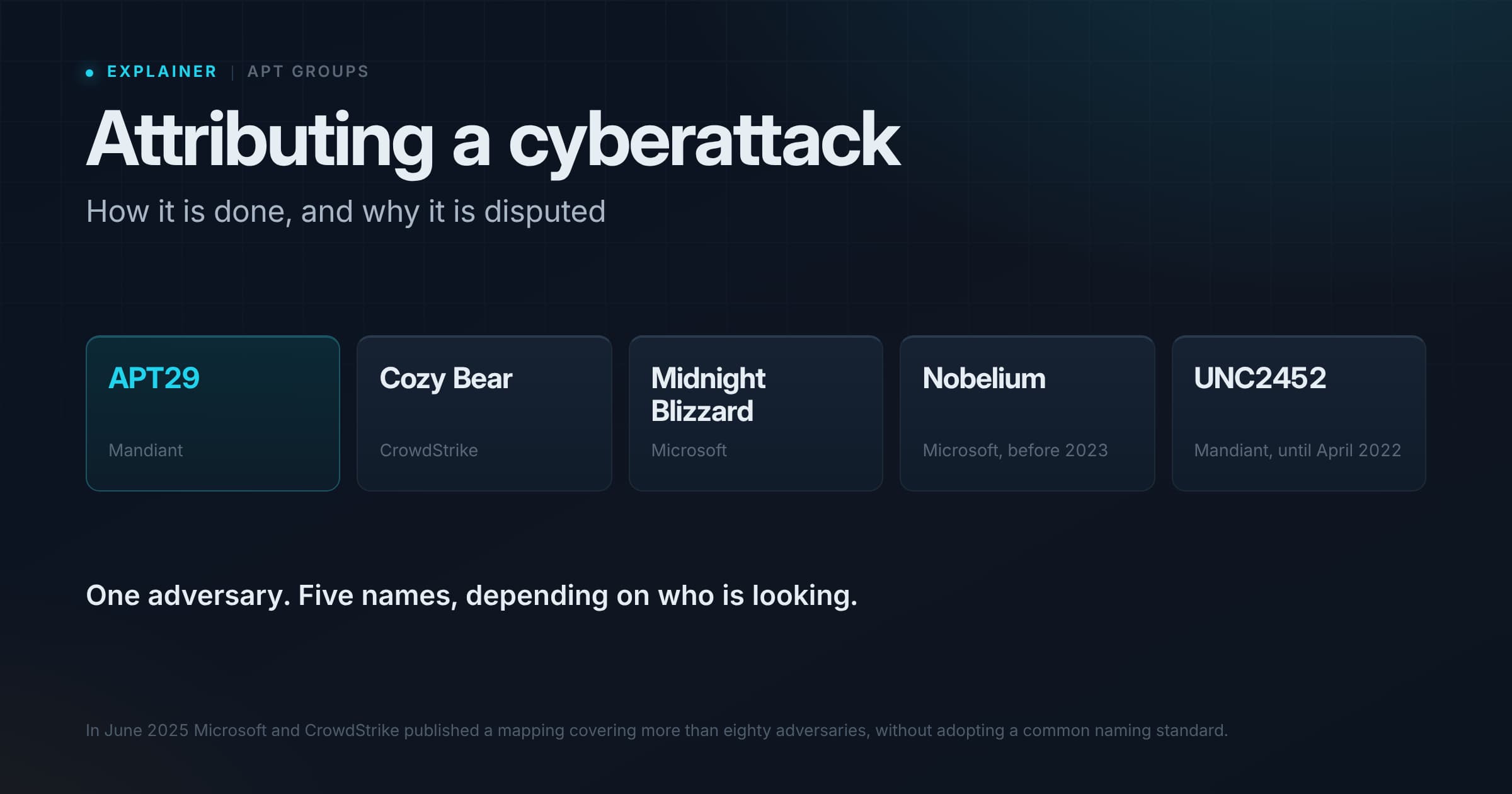
Attributing a cyberattack: the method, and why it is disputed
APT29, Cozy Bear, Midnight Blizzard: three of the five names one group carries. What technical evidence can establish, what it cannot prove, and who decides.
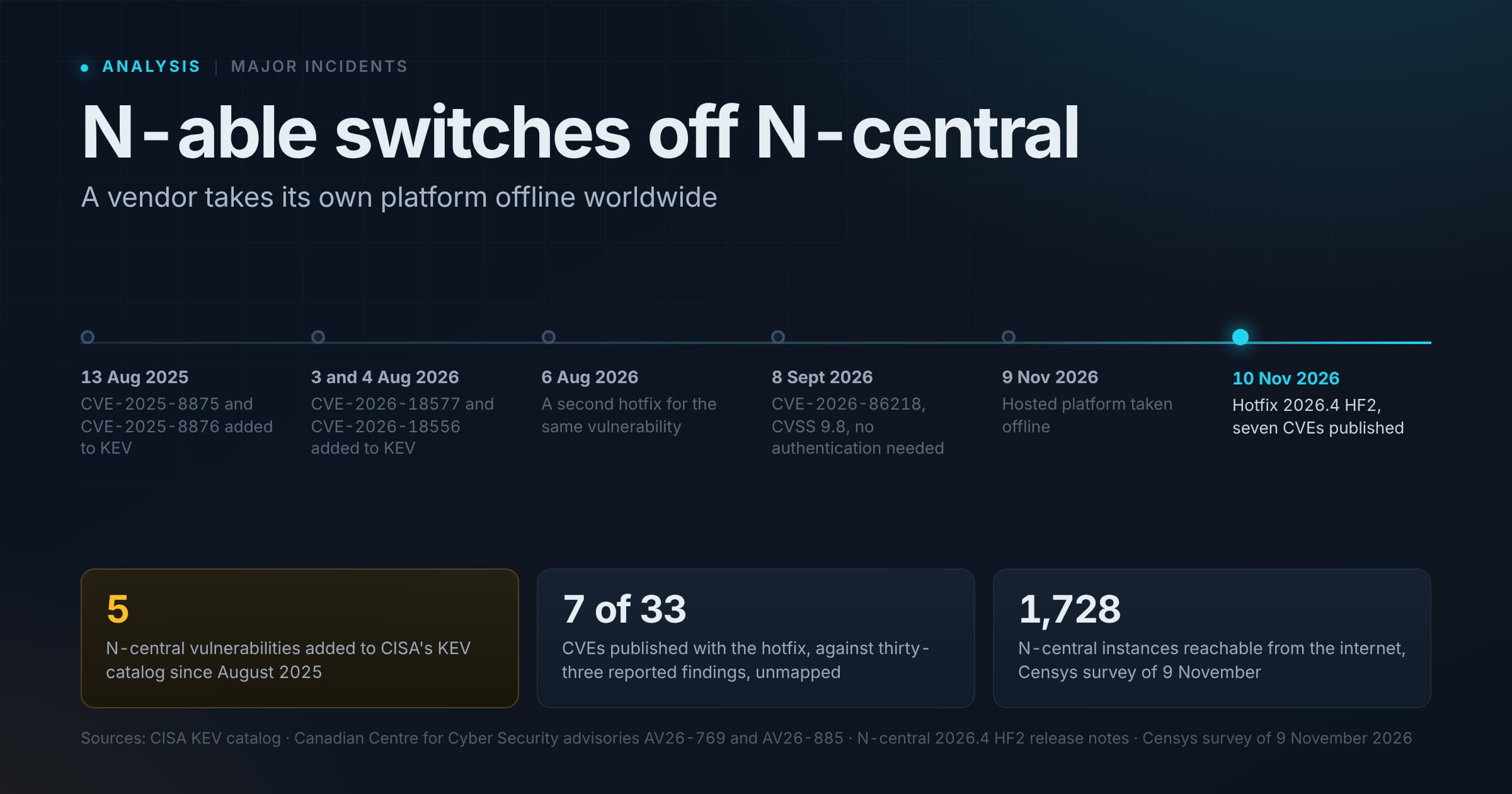
N-able switches off N-central: a vendor takes down its own platform
Able2Shell: seven CVEs fixed, then fresh exploit chains claimed against the hotfix. What the N-central affair says about the tools that run other people's IT.
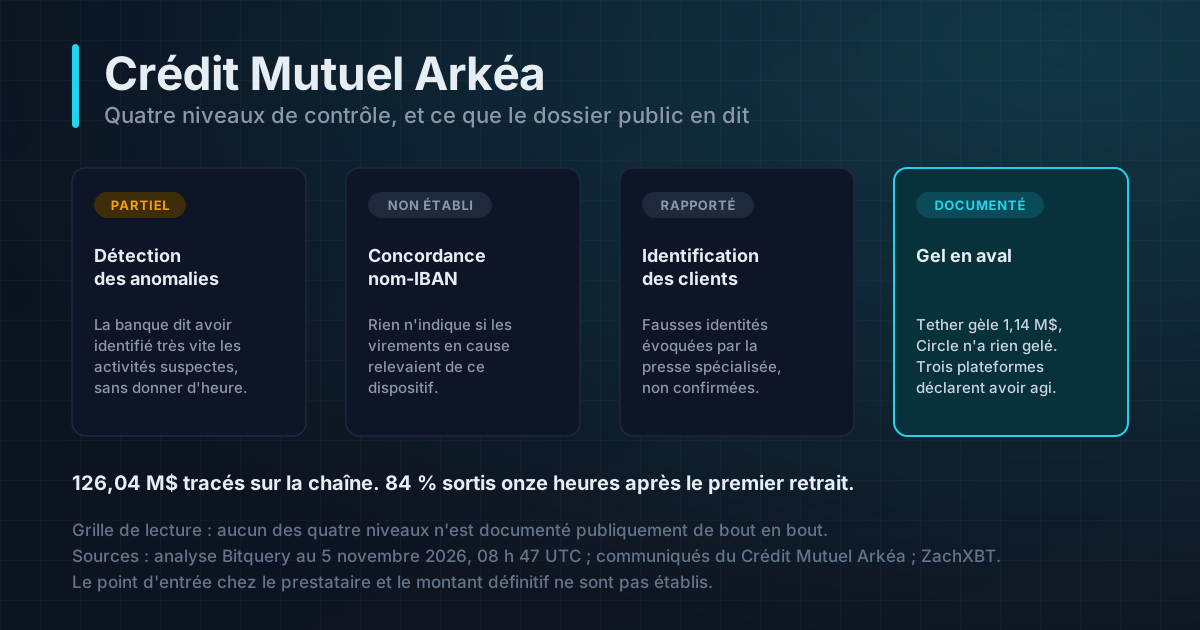
Crédit Mutuel Arkéa: what the controls could see
Four levels of control sit between a bank transfer and its conversion into crypto. In the Crédit Mutuel Arkéa case, only one produced a documented effect.