


Cybersecurity Act 2: what Brussels is rewriting while Paris transposes
France transposes NIS2 two years late while Brussels prepares its revision. The Senate challenged the package on subsidiarity; the Commission amended nothing.
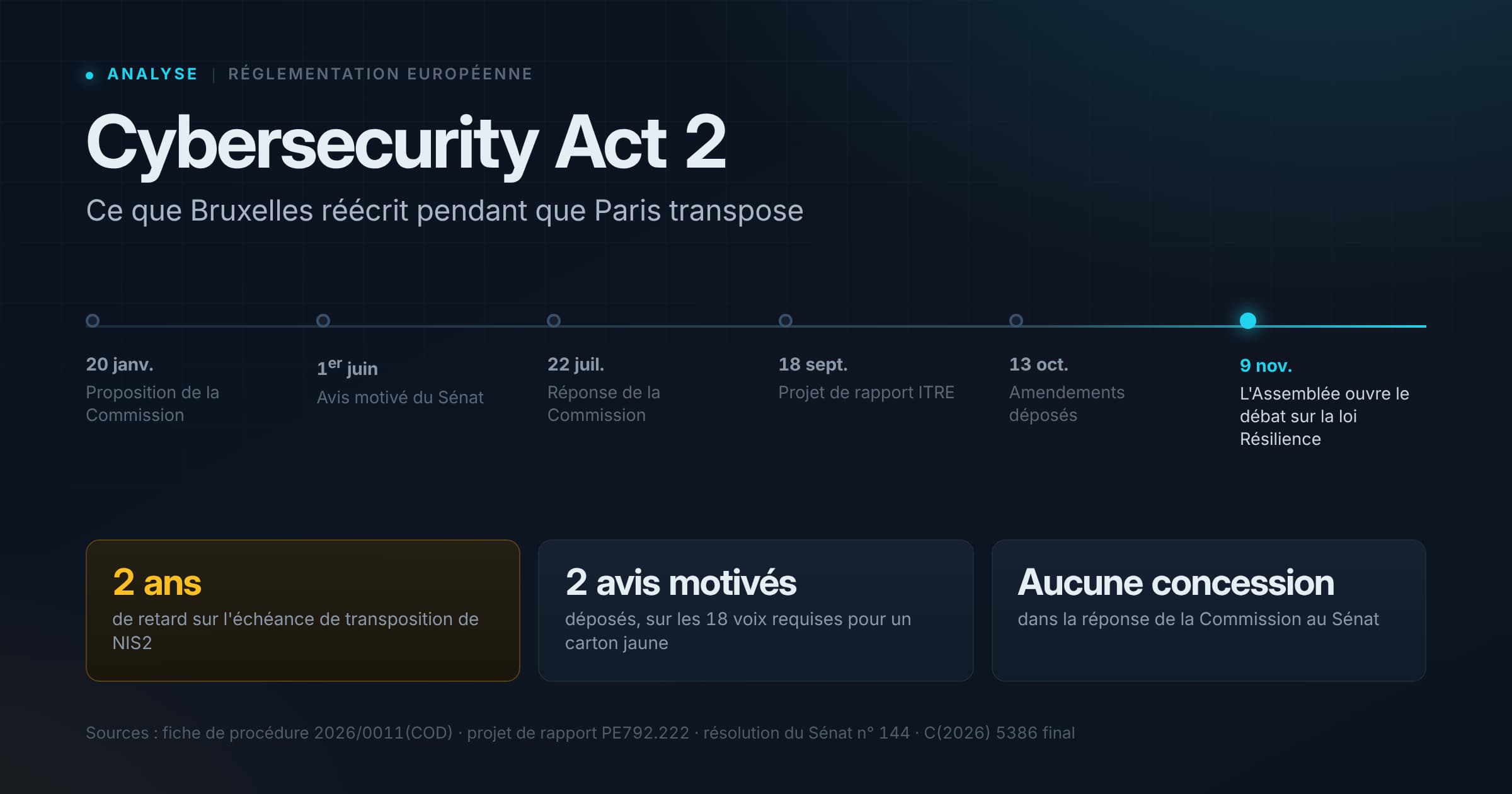
The French National Assembly opens debate on Monday on the Résilience bill, which transposes the NIS 2 (Network and Information Security) directive into French law. The European deadline for transposition was 17 October 20241.
Brussels, meanwhile, has already moved on. The package tabled on 20 January 2026 contains two separate instruments: a proposed regulation, the Cybersecurity Act 2, covering ENISA, certification and supply chain security2, and a proposed directive amending NIS2 to simplify parts of it and align it with the first3. The French Senate challenged both in the spring on subsidiarity grounds. The Commission replied in July and changed nothing.
What the Commission put on the table
The proposed regulation replaces the 2019 Cybersecurity Act, broadens the mandate of the European Union Agency for Cybersecurity (ENISA), and rests on Article 114 of the Treaty on the Functioning of the European Union, that is, on internal market competence4.
Three provisions drew most of the fire. Article 16 provides for a European database of unpatched vulnerabilities, managed by ENISA. Article 58 requires every Member State to designate at least two liaison officers to the agency. Title III reorganises certification governance, narrowing the role of national authorities in designing schemes.
The text also sets out a mechanism for designating high-risk suppliers, built on first identifying third countries considered to pose a risk, along with a reporting entry point limited to a single category of threat.
What "certification" means here
The word comes up often enough in this file to be worth pinning down.
The framework created by the 2019 Cybersecurity Act does not certify companies. It certifies ICT products, services and processes. It works through schemes: for each category, a separate framework sets out what is assessed and by what method. A scheme is prepared by ENISA at the Commission's request, then adopted by the Commission.
Only one is in service today. The European cybersecurity certification scheme on Common Criteria (EUCC), built on ISO/IEC 15408, covers ICT products: chips, smartcards, hardware, software. The first certificates could be issued in February 2025. It has two assurance levels. At "substantial", the certification body and the evaluation laboratory must be accredited. At "high", they must additionally be authorised by the national certification authority, which in France is ANSSI5.
This is the vocabulary Amendment 63 borrows. Making certification mandatory by default would mean that a product or service falling under an existing scheme would have to be certified to reach the European market, rather than certified at the supplier's discretion.
The scheme France cares about most does not exist. The European cybersecurity certification scheme for cloud services (EUCS) has been in preparation since 2020. The November 2023 draft provided for a top level requiring the provider to be established in the Union, to cap non-EU shareholdings and to be shielded from extraterritorial law. Those requirements were removed or substantially weakened in the March 2024 version: France, Italy and Spain supported them, Germany and the Netherlands did not6.
The deadlock has a textual cause. In its 2019 form, the Cybersecurity Act allows a scheme to be built only on technical criteria, and immunity from a foreign law is not one. The Commission presents the current revision as the way out, by opening schemes to non-technical risk factors7. Making certification mandatory while the cloud scheme does not exist, and while its sovereignty criterion has been stripped out, is therefore not a procedural question.
What the rapporteur proposes to make of it
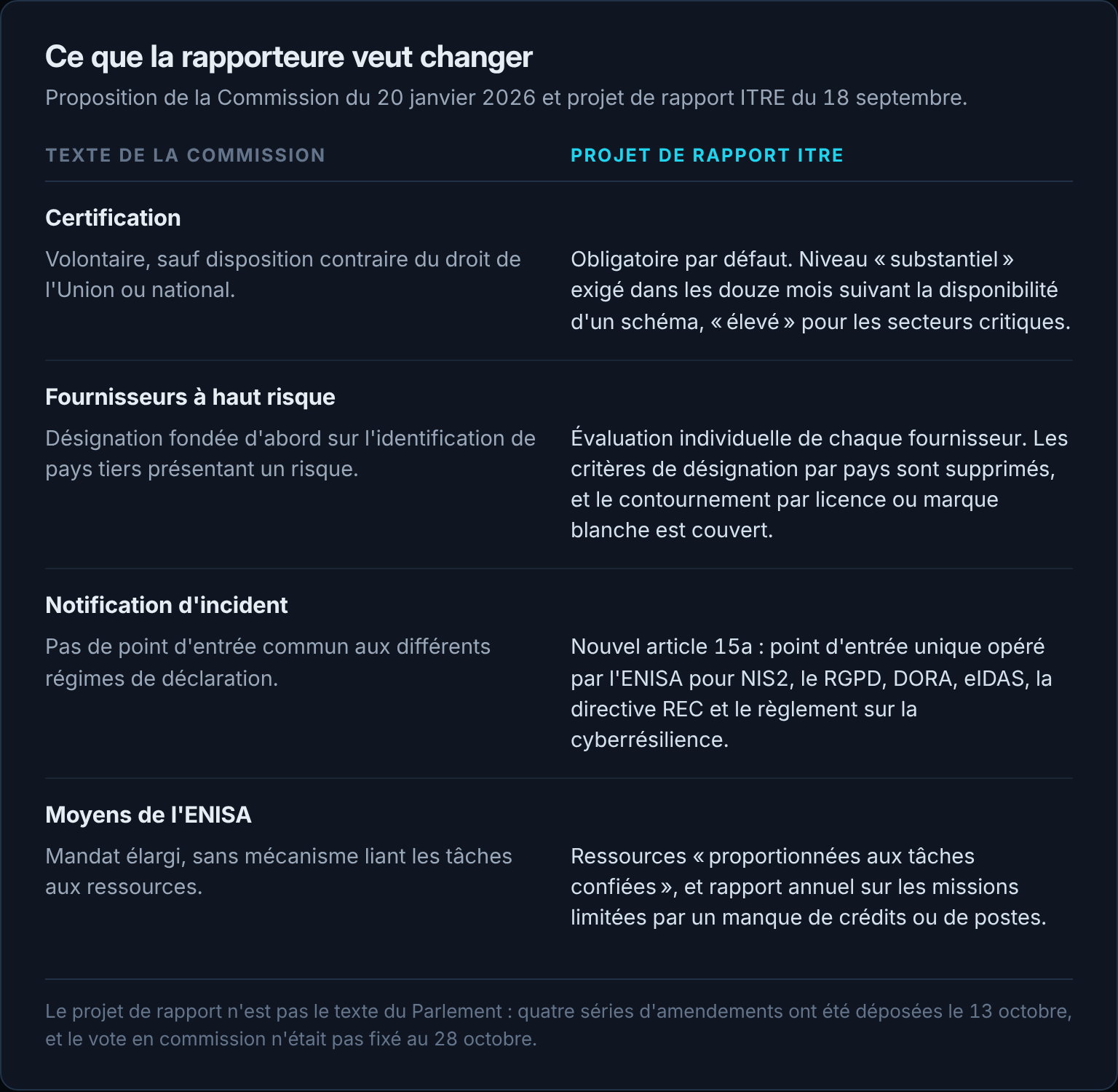
The European Parliament's committee on industry, research and energy (ITRE) appointed Markéta Gregorová (Greens/EFA) as rapporteur in February. Her draft report, tabled on 18 September, does not tinker at the edges8.
The sharpest change concerns certification. Where the Commission makes it voluntary unless otherwise provided, Amendment 63 flips the default: European cybersecurity certification "shall be mandatory, unless otherwise expressly provided in Union law". Amendment 64 would require Annex I entities to hold a certificate at "substantial" assurance within twelve months of a scheme becoming available, and at "high" for sectors identified as critical.
The second change is quieter and probably carries further. Amendments 99 to 103 would delete the criteria for designating risky third countries, and Amendment 28 redefines a high-risk supplier around an individual assessment. The mechanism would stop being a list of countries and become an adversarial procedure, supplier by supplier, with a response deadline capped at thirty working days. Amendment 110 extends the measures whatever the corporate arrangement: licensing, white-labelling, local assembly or minority shareholdings.
Amendment 43 then creates an Article 15a giving ENISA a single entry point for notifications, far broader than the Commission's: it would cover NIS 2, the General Data Protection Regulation, the Digital Operational Resilience Act (DORA), the electronic identification and trust services regulation (eIDAS), the directive on the resilience of critical entities (CER) and the Cyber Resilience Act. National authorities and incident response teams would continue to receive the notifications.
None of this is settled. A draft report is a rapporteur's text, not Parliament's. Four sets of amendments were tabled on 13 October, and in early November the procedure still stood at awaiting committee decision4.
What the Senate objected to
On 13 May the Senate adopted a resolution containing a reasoned opinion on both proposals, tabled by Catherine Morin-Desailly and Audrey Linkenheld on behalf of its European affairs committee9. The European Parliament registered it on 1 June4.
The explanatory statement grants that the Commission's cross-border rationale "is understandable on a first reading", then holds that cybersecurity "touches on national sovereignty in several respects"9. The central argument comes from Article 4 of the Treaty on European Union: national security remains the sole responsibility of each Member State. The rapporteurs do not dispute Article 114 as a legal basis so much as the reach of the measures, which they consider encroaches on reserved ground.
On Article 16 the opposition is head-on: pooling unpatched vulnerabilities in a European database would weaken each State's ability to manage flaws in its own critical infrastructure. On Article 58, two liaison officers per State are called counterproductive, and the agency's staffing increase is framed as a levy on skills already scarce nationally.
On certification, the Senate relays a warning from ANSSI that Member States' expertise would slip to a secondary role. What sits behind that phrase is the fate of SecNumCloud, the French qualification that currently requires immunity from extraterritorial law and that Paris wanted reflected in the top level of EUCS. If scheme governance moves to the European level without that criterion being restored, the national qualification loses its natural outlet.
The Commission's single entry point draws a more practical criticism: covering one threat axis only, it would leave entities unsure whom to approach.
The text is careful to note that France's own transposition delay does not alter the competence question. The remark is honest, and it keeps the argument on legal ground rather than on the record of delivery.
The Commission's reply
It is dated 22 July, signed by Henna Virkkunen and Maroš Šefčovič, and addressed to the President of the Senate10.
On the agency's operational role the wording is flat: ENISA "is not, and will not become, an incident response centre", and its activities "will not interfere with the primary role of national authorities". More broadly, the proposal "only provides for strengthening ENISA's supporting role without encroaching on national competences".
On the liaison officers, the Commission notes the concerns and holds its ground: designating two was "deemed necessary" to build both national expertise and collective capacity.
The letter closes on the hope that these clarifications will ease the Senate's concerns, and on the observation that the proposals remain under negotiation between Parliament and Council. No amendment is announced in it.
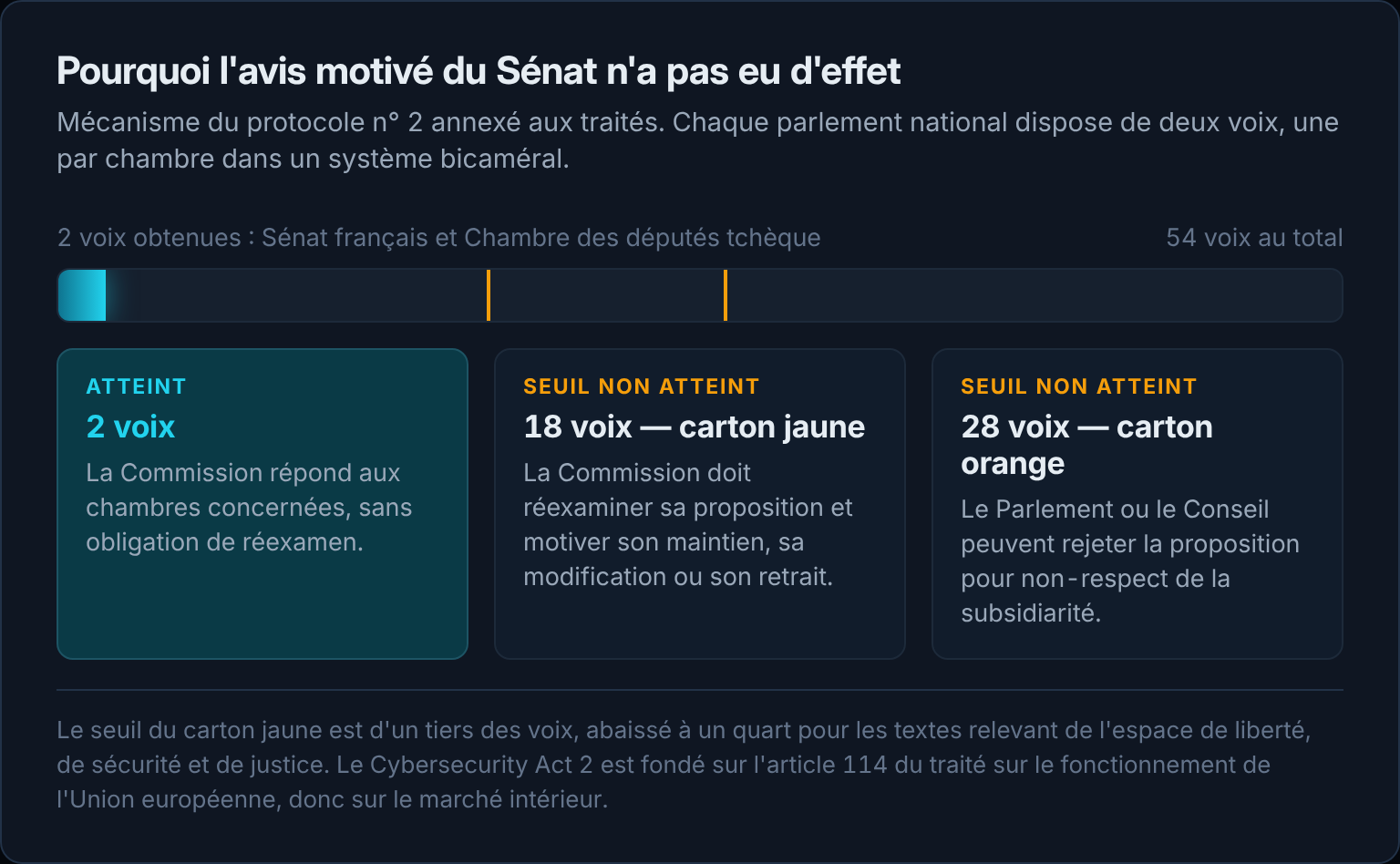
None was required. Only two chambers filed a reasoned opinion on this text, the French Senate and the Czech Chamber of Deputies: two votes out of the fifty-four allocated across national parliaments4. The threshold that triggers mandatory review is eighteen.
A competence objection, an engineering answer
Something is slightly out of step between the Senate's objection and the draft report. The two documents are not in dialogue: the resolution dates from May, the draft report from September, and nothing suggests the rapporteur wrote with the reasoned opinion in view. They are two approaches to one problem, four months apart.
The Senate asks who holds what: who decides, who stores, who answers for it. The draft report answers largely through design. Its single entry point comes with precise technical guarantees: a federated architecture in which no component holds data for more than one Member State, end-to-end encryption, deletion of content within seventy-two hours, an independent security audit before each activation8.
Those guarantees are not without legal weight. Keeping national authorities and response teams as recipients of the notifications addresses part of the fear of dispossession, and separating data by Member State limits concentration. But the Senate's objection is drawn from the Treaties, not from architecture: it rests on subsidiarity and proportionality. I doubt a technical guarantee, however sound, can settle that, and the committee debate will show whether other groups share the doubt.
The curious part lies elsewhere. On several of the points that worry the Senate, the rapporteur goes further than the Commission: she would make certification mandatory by default and hand ENISA one more system to run. She pairs this with budgetary safeguards — resources "commensurate with the tasks assigned", an annual report on work held back for want of funds or posts — which answer part of the French concern about staffing, though from above, by consolidating the agency rather than restraining it.
What is at stake in Paris this week
The Résilience bill transposes three 2022 instruments: the directive on the resilience of critical entities, NIS2, and the directive accompanying the DORA regulation. The Senate adopted it in March 2025. It was due in the July extraordinary session, slipped to 7 October, then came off the agenda for want of parliamentary time. Public debate is scheduled from Monday 9 to Friday 13 November, the 11th excepted1.
So the Assembly will transpose a directive whose targeted amendment is already before the European Parliament, in a package the Senate of the same Republic has found contrary to subsidiarity.
For an organisation that has to reach compliance, the practical consequence is less daunting than it sounds, provided the work is sequenced. The NIS2 risk management measures — governance, risk analysis, incident handling, supply chain security, continuity — are the foundation, and the amending directive concerns simplification and alignment, not their removal. The uncertainty sits elsewhere: in the certification requirements to come, which hang on the fate of Amendment 63, and in some of the supervisory arrangements. Building the foundation now carries no risk. Sizing a certification programme today carries a good deal more.
What to watch
No committee vote date had been set by the end of October. Parliamentary discussions are meant to conclude before the year is out, but the text then has to be negotiated with the Council, and the amendments tabled on 13 October have yet to be arbitrated.
The item to follow closely is the deletion of the country-designation criteria. It would move the decision towards an individual assessment of suppliers, making designations less directly diplomatic without depoliticising them: building a case supplier by supplier can prove just as sensitive, and about the same companies. The real cost will depend on the criteria adopted and the number of cases opened. If the amendment survives the trilogue, the question to put to the Commission is what investigative capacity it intends to devote to them.
Sources & notes
-
Silicon.fr, "NIS 2, le projet de loi de retour le 9 novembre", 5 November 2026 (in French), https://www.silicon.fr/cybersecurite-1371/nis-2-le-projet-de-loi-de-retour-le-9-novembre-230126 ↩ ↩2
-
European Commission, proposal for a regulation COM(2026) 11 final, procedure 2026/0011(COD), 20 January 2026, https://eur-lex.europa.eu/procedure/EN/2026_11 ↩
-
European Commission, proposal for a directive amending Directive NIS 2, COM(2026) 13 final, procedure 2026/0012(COD), 20 January 2026, https://eur-lex.europa.eu/legal-content/EN/TXT/HTML/?uri=COM:2026:13:FIN ↩
-
European Parliament, procedure file 2026/0011(COD), accessed 7 November 2026, https://oeil.europarl.europa.eu/oeil/en/procedure-file?reference=2026%2F0011%28COD%29 ↩ ↩2 ↩3 ↩4
-
ENISA, « EUCC — European Union Cybersecurity Certification », consulté le 9 novembre 2026, https://certification.enisa.europa.eu/browse-topic/eucc_en ↩
-
IT Social, « EUCS et CADA : l'Europe abandonne la souveraineté dans son label cloud et la réintroduit dans la commande publique », 8 juin 2026, https://itsocial.fr/cybersecurite/cybersecurite-articles/eucs-et-cada-leurope-abandonne-la-souverainete-dans-son-label-cloud-et-la-reintroduit-dans-la-commande-publique/ ↩
-
Journal du Net, « EUCS : vers un déblocage (enfin) ? », 20 juin 2025, https://www.journaldunet.com/cybersecurite/1542509-eucs-vers-un-deblocage-enfin/ ↩
-
European Parliament, ITRE committee, draft report PE792.222, 18 September 2026, https://redmapl3.europarl.europa.eu/RedmapFront/media/reds_iCmRp-Dft/ITRE-PR-792222/ITRE-PR-792222_en.pdf ↩ ↩2
-
Sénat, proposition de résolution européenne no 624 containing a reasoned opinion, which became resolution no 110 on 13 May 2026 (in French), https://www.senat.fr/dossier-legislatif/ppr25-624.html ↩ ↩2
-
European Commission, reply to the reasoned opinion of the French Senate, C(2026) 5386 final, 22 July 2026 (in French), https://www.senat.fr/europe/avis_motives/C_2026_5386_FR_ACTE_f.pdf ↩
Comments (0)
Leave a comment
Have an account? Sign in to comment with your account
No comments yet. Start the conversation!
Read next
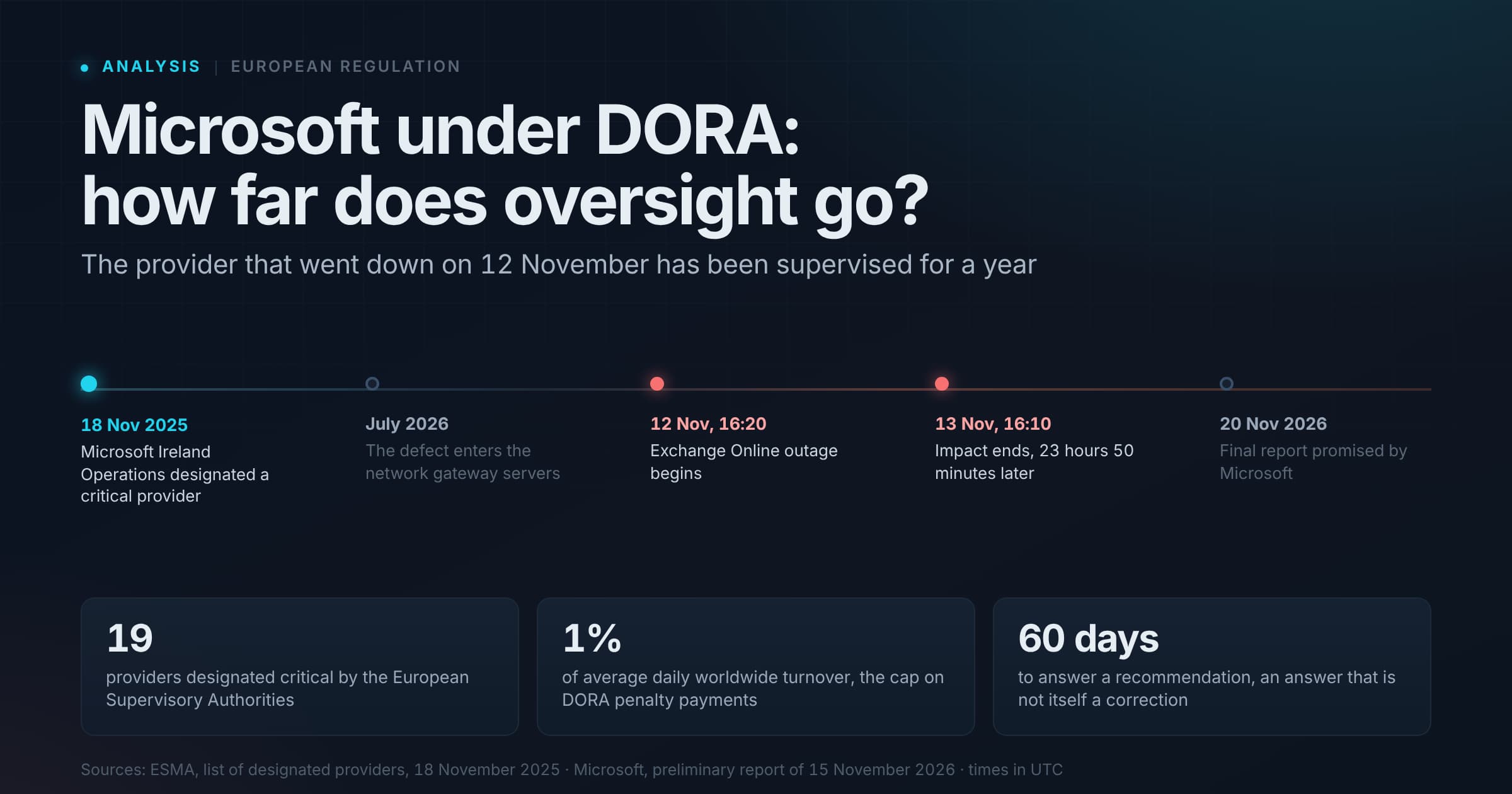
Microsoft under DORA: how far does European oversight go?
Microsoft Ireland Operations has been under direct European oversight since 18 November 2025. The November outage shows how far that power actually goes.
NIS2: what the directive actually requires, and where France stands
Wider scope, accountable directors, reporting within 24 hours: what NIS2 actually requires, and why France's delay is no reason to wait before preparing.