


Microsoft under DORA: how far does European oversight go?
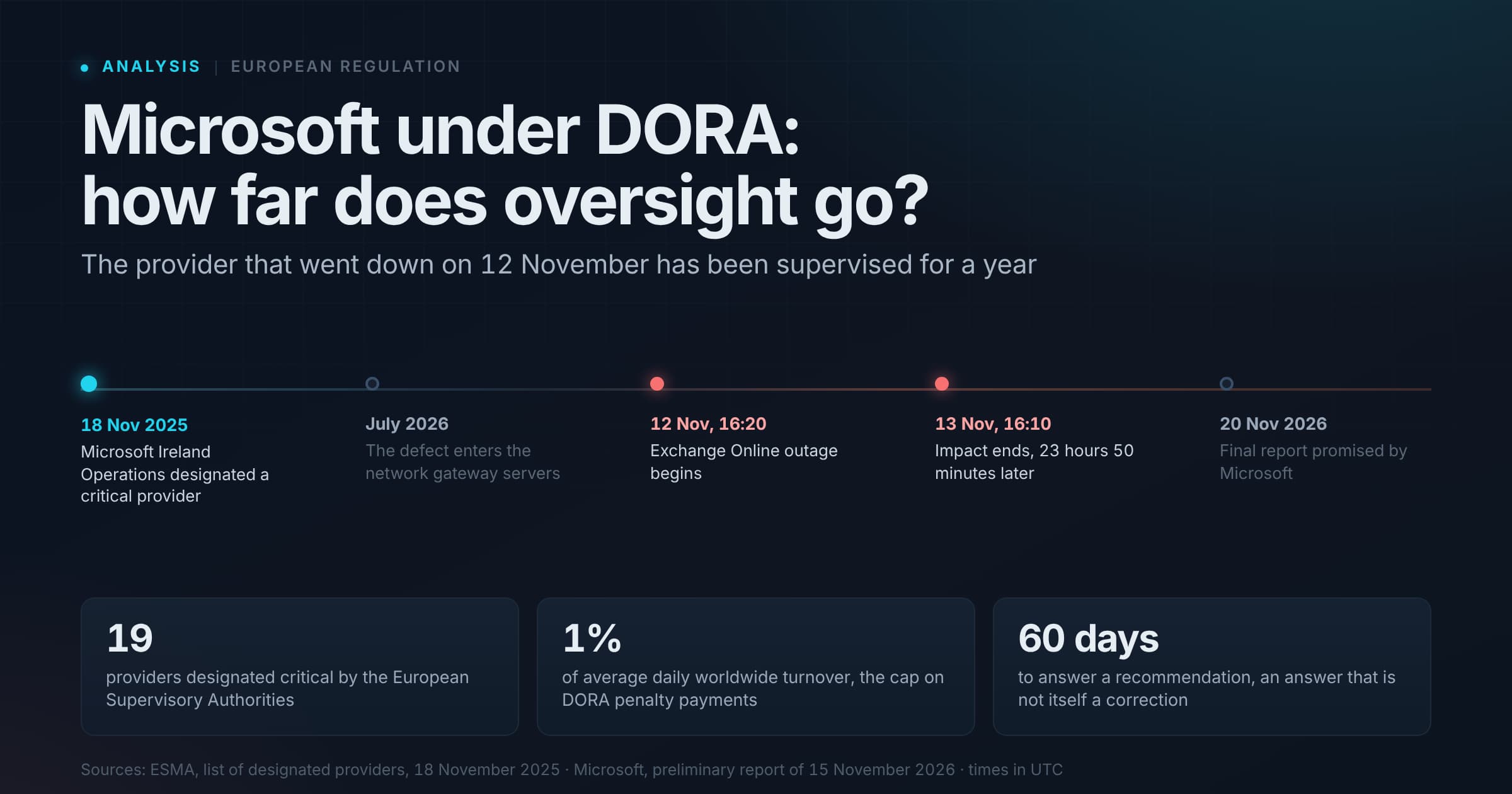
Microsoft Ireland Operations has been under direct European oversight since 18 November 2025. The November outage shows how far that power actually goes.
For the twenty-four hours that Microsoft's email service stayed out of reach, the question asked across Europe was whether it should build a cloud of its own. The question is a fair one. It is asked as though nothing existed.
Something does exist, and it names names. Microsoft Ireland Operations Limited has appeared since 18 November 2025 on a public list of nineteen companies placed under the direct oversight of the European Supervisory Authorities, under Regulation (EU) 2022/2554 on digital operational resilience for the financial sector, known as DORA1. A Lead Overseer is assigned to it, and can demand documents, run investigations, inspect its premises and impose daily penalty payments.
How far that power goes is the question. DORA never promised an absence of outages, and nothing public connects the overseer's work to the defect that caused this one. But the regulation can be read, and reading it says fairly precisely what Europe can require of a provider this size, what it cannot impose on one, and who it leaves outside the arrangement.
A software defect, not an attack
The Exchange Online incident carries the reference EX1550543, the wider advisory MO1550821. It began on Thursday 12 November 2026 at 16:20 UTC and impact ended on Friday the 13th at 16:10, twenty-three hours and fifty minutes later. Those are the incident's boundaries, not the experience of any individual user, which varied by region and connection method2.
The preliminary report Microsoft issued on 15 November describes three factors combining: a latent defect, a surge in load and roughly 14% of gateway capacity out of service. The defect is a lock-contention problem introduced into the network gateway servers by a July 2026 update, itself meant to fix those same gateways. Under load, the machines exhaust CPU and memory and stop responding. The trigger was an automatic Teams failover onto the gateway shared with Exchange Online some fifteen hours earlier; partition isolation failed to contain the failure23. Microsoft says it found no malicious activity, and the final report with the list of repair items is promised for 20 November2.
Nothing in that chain turns on a provider's nationality or the law it answers to. It is a code defect, made worse by shared capacity between services. The risk that materialised is concentration: a great many organisations depend on the same component, and that component gave way. It resembles a vendor shutting down its customers' platform itself more than it resembles a question of jurisdiction.
Nineteen names, Microsoft among them
The designation came not from the Commission but from the three European Supervisory Authorities: the European Banking Authority, the European Insurance and Occupational Pensions Authority and the European Securities and Markets Authority. They proceeded in three stages: collecting the registers of information that financial entities keep on their ICT service arrangements, assessing criticality together with the national competent authorities, then formally notifying the selected providers, who had six weeks to exercise their right to be heard before the final decisions45.
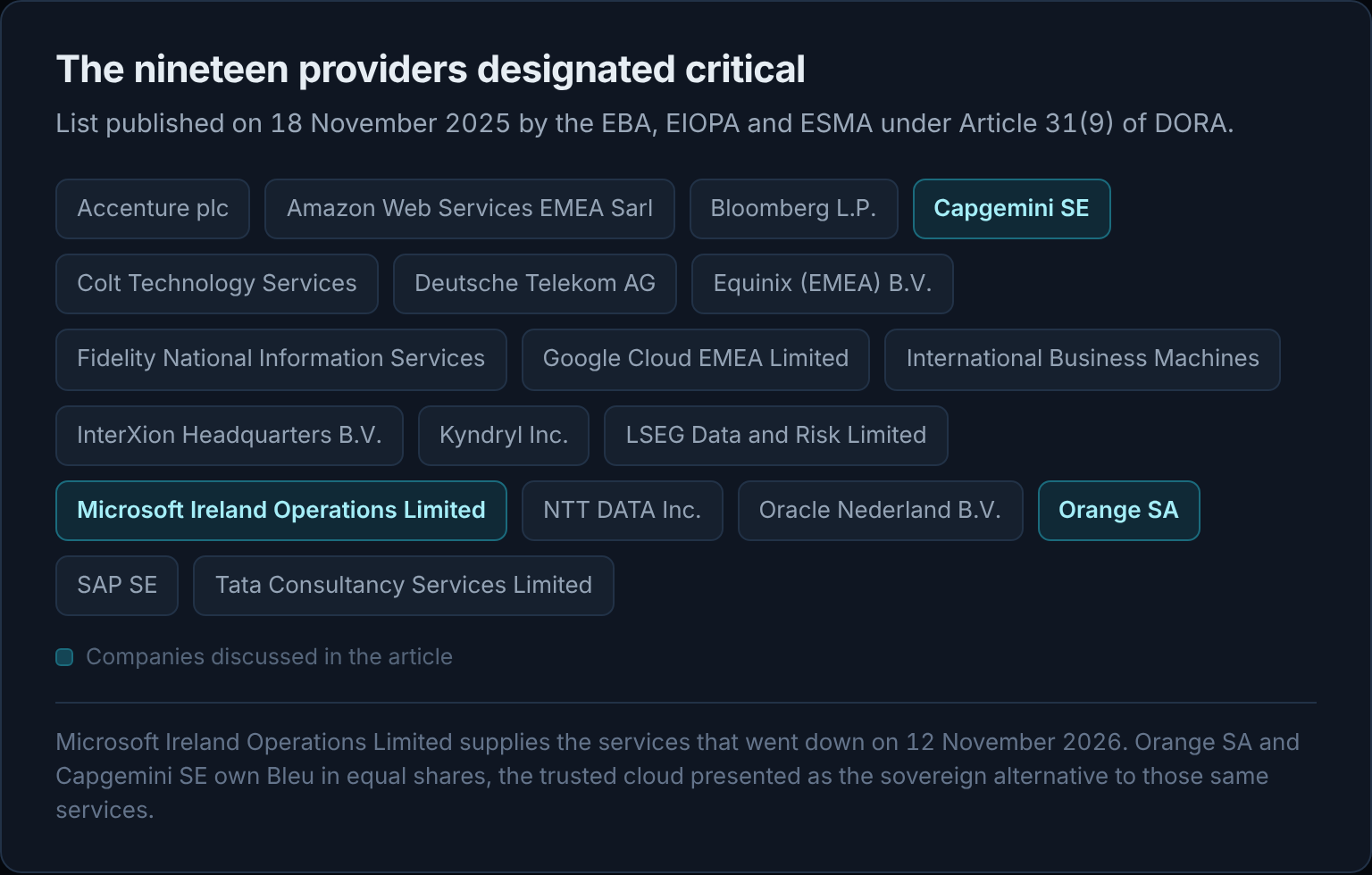
The list spans four families: cloud providers, software vendors, integrators and managed service firms, and operators of data centres and networks, with two financial data providers alongside them. It is reviewed annually1.
Two names there are worth pausing on. Orange SA and Capgemini SE own Bleu in equal shares, the joint venture created to offer French organisations a trusted alternative to Microsoft's services. Their place on the list comes from their own services to the financial sector, not from that shareholding: Bleu itself is not designated. It says something all the same about the structure of the European market, where the shareholders of the sovereign alternative are themselves companies whose failure, in Europe's assessment, would put the financial system at risk.
Binding investigative powers, recommendations that bind nothing
Article 35 of DORA sets out what the Lead Overseer may do. It requests any relevant information, conducts general investigations and inspections, calls afterwards for reports on remedial action, and issues recommendations. Those recommendations may address security, contractual terms designed to prevent a single point of failure or limit concentration risk, and planned subcontracting6.
The penalty payments are real, and they do bind. They are capped at 1% of the provider's average daily worldwide turnover in the preceding business year, accrue daily for a maximum of six months, and may be decided only at least thirty days after the measures concerned were notified6. One detail bounds their reach: they punish a refusal to supply information, to submit to an investigation or to deliver a report. A reasoned refusal to follow a recommendation does not on its own trigger them.
What becomes of a recommendation that is not followed is governed by Article 42.
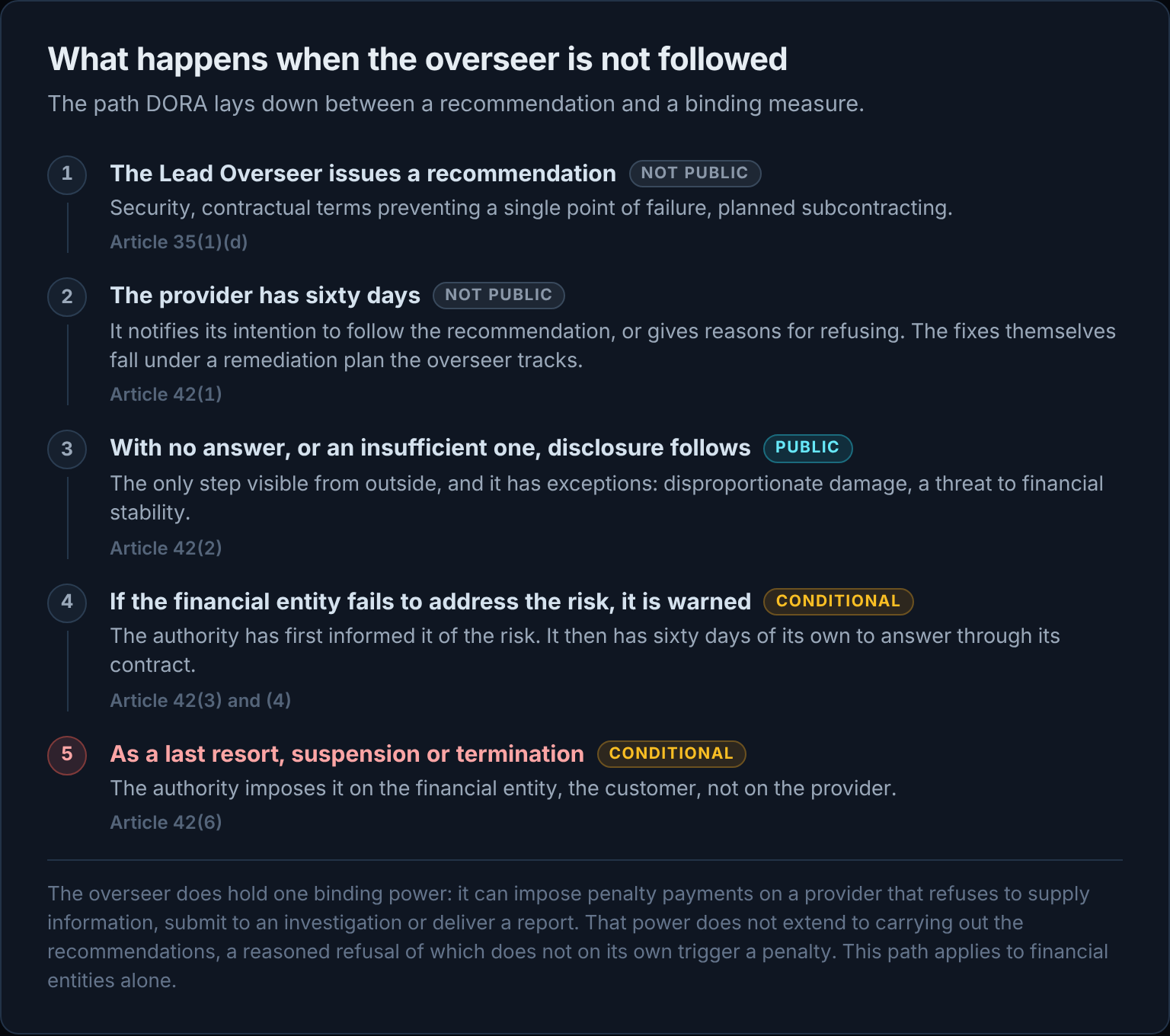
The provider has sixty days to notify its intention to follow the recommendation or to give reasons for refusing. That is a deadline for answering: if it accepts, the fixes then fall under a remediation plan and progress reports the overseer tracks5. Where no answer comes, or the explanation is judged insufficient, the breach is disclosed publicly, except where disclosure would cause disproportionate damage or threaten market stability. The competent authority then informs the financial entities of the risk identified, and those entities must take it into account. If one of them does not do so sufficiently, the authority warns it that a decision may follow, gives it sixty days of its own to address the risk through its contract, and may as a last resort require it to suspend all or part of its use of the service, or to terminate it6.
The last two steps are conditional, and they are aimed at the customer. A bank can be ordered to stop using Exchange Online. The overseer can compel Microsoft to cooperate with its investigations; it holds no equivalent power to make it carry out a technical recommendation.
This is not a drafting weakness but the logic of a regime built on the supervision of financial entities. The Union gave itself the means to see, to document and to deprive a provider of its regulated customers, not the means to order a service restored from a company it does not regulate directly.
What the oversight produces is not public
An outside observer cannot say what the overseer has done since November 2025: whether an oversight plan covered the gateway infrastructure, whether an inspection took place, whether a recommendation was issued. That ignorance is not a gap in the record.
The oversight guide the three authorities published on 15 July 2025 describes a four-stage cycle: annual designation; an annual assessment of each provider's risk profile and the preparation of an individual annual plan set within a three-year multi-annual plan; examinations, covering ongoing monitoring, information requests, general investigations and inspections; and finally recommendations and the follow-up of remediation plans. The document fixes precise deadlines, among them three months to adopt a recommendation after an investigation or inspection closes, and thirty days for the provider to comment on a draft recommendation's effect on its customers5.
One sentence in the guide settles the question: these recommendations are non-public5. Providers receive them, competent authorities are informed, financial entities are made aware of the associated risks. What becomes public is only the identity of a provider that fails to follow a recommendation and the nature of its breach. The opinions the overseer may issue to competent authorities are not public either.
No breach has been published concerning Microsoft. That absence does not reveal whether recommendations were addressed to it, whether they were followed, whether a refusal was judged sufficiently reasoned, or whether the procedure ever reached that stage. Nor does it rule out the exceptions to disclosure the regulation provides for. The regime is built so that the question has no public answer.
The French supervisor describes the arrangement in measured terms. On 9 September 2026, before the Association des avocats en droit boursier, a French association of securities lawyers, Denis Beau, first deputy governor of the Banque de France and president-designate of the Autorité de contrôle prudentiel et de résolution, France's prudential supervisor for banks and insurers, devoted a speech to the financial sector's exposure to dependency. He states there that cyber risk and sovereignty risk are "two sides of the same problem", cites a study commissioned by Cigref, the association of large French companies and public bodies on digital matters, putting European spending on American cloud and software services at €264 billion a year, and notes that the prospect of a switch thrown from the United States is now under examination by the French government. On DORA, his wording repays attention: by placing critical providers under a common framework, the regulation allows supervisors to assess "concentration, dependency and technological lock-in risks"7. To assess. The verb is exact, and it is more modest than to correct.
Outside finance, another authority, in another country
The outage drew no distinction between sectors. The hospitals, public bodies, schools and companies that lost their email lost it for the same reason the banks did. It would be wrong to conclude that no rule reaches their provider.
A cloud computing provider falls under the regime derived from Directive (EU) 2016/1148, known as NIS, transposed in France by the law of 26 February 2018. There it is a digital service provider from fifty employees or ten million euros in annual turnover, with no authority having to designate it, and must report without delay any incident having a significant impact. The term has a numerical definition: one of its four alternative criteria is met when unavailability exceeds five million user-hours in the Union, which over twenty-four hours is roughly 208,000 users continuously affected8.
Which authority that report would be owed to is the next question. Article 11 of the French law applies the regime only to providers whose registered office or main establishment is in France, or who have designated a representative there9. The 2016 directive sets the rule in its Article 18: the main establishment is in the Member State where the provider has its head office10. The entity Europe designated as a critical provider has its head office in Ireland.
NIS2 keeps jurisdiction attached to the main establishment but changes how that is identified. Its Article 26 gives priority to the Member State where decisions on cybersecurity risk-management measures are mainly taken, with fallback criteria where that place cannot be determined; a head office's location alone will therefore no longer settle which authority is competent. The same article also allows a Member State that receives a mutual assistance request to take, within the limits of that request, supervisory and enforcement measures against the provider on its territory11. The French transposition, adopted at first reading on 17 November 2026, does not alter this architecture, and not every affected organisation will fall within the directive's scope automatically, since application depends on sector, size, the entity's status and the options each Member State takes.
Two things are therefore distinct. Oversight of the provider does not follow its customers: it is exercised principally from the State where that provider is established, and the reform under way may move which State that is without bringing the oversight closer to French organisations. Those organisations, for their part, remain bound by their own obligations, including on managing their suppliers. Depending on a provider supervised elsewhere exempts them from nothing.
Bleu held, and why
That leaves the case French readers will care about most. According to Alloforfait, Bleu's chief executive Jean Coumaros said the platform's collaboration services, Teams and Outlook included, were unaffected, the reason given being that Bleu runs infrastructure physically separate from Microsoft's12.
The explanation is consistent with what Coumaros described in August 2024: ten thousand servers deployed by Bleu, two data centres in France, and a requirement on Microsoft to port Azure and Microsoft 365 onto a stack that is not its own, with Bleu's teams then operating those services. SecNumCloud qualification in fact presupposes full separation, with Microsoft's teams having left the sites13.
The episode therefore gives a concrete example of how separate infrastructure limits the spread of a common failure. It does not show that Bleu would be safe from every Microsoft outage, particularly those arising from shared software components, since the software itself remains Microsoft's. The dependency does not vanish by changing operator: it moves, much as third-party code running with the rights of the site hosting it does not become harmless because it arrives from a trusted domain.
The scale bears repeating. Bleu has not yet obtained SecNumCloud qualification; its J1 milestone was accepted in November 2025 and qualification is targeted for December 2026, with the Microsoft 365 component deferred to a second stage14. At the end of October 2026 its catalogue ran to about a hundred services, sixty of them generally available, for some sixty customers, of whom it is not known how many were using Outlook or Teams on the platform15. A separate architecture works; it is not yet available at the scale of the problem.
The perimeter, not the instrument
Europe is not empty-handed against concentration risk. It holds an instrument that names the companies concerned, assigns each a supervisor, and gives that supervisor powers of investigation and inspection backed by penalty payments that genuinely bind. What the instrument does not do is oblige a provider to repair a service. Nor does it make its own work visible.
And it covers one sector. For that provider's other customers the obligations exist, but the oversight that backs them is exercised from the State where the provider is established, and the reform under way changes the connecting criterion without bringing the authority closer.
What is left to the non-financial organisation is therefore its own work, and it waits on no legislation: knowing which services stop when that provider stops, how long the business can absorb it, and what has been arranged for email, authentication and file sharing during those hours.
Position as at 18 November 2026. Microsoft's final report is promised for 20 November, and the list of critical providers is reviewed annually.
Sources & notes
-
ESMA, EBA and EIOPA, "List of designated critical ICT third-party service providers", under Article 31(9) of Regulation (EU) 2022/2554, 18 November 2025, https://www.esma.europa.eu/sites/default/files/2025-11/List_of_designated_CTPPs.pdf ↩ ↩2
-
Microsoft, preliminary post-incident report of 15 November 2026, incidents EX1550543 and MO1550821, available to administrators in the Microsoft 365 admin center; summary published by 365Fanatic, https://www.365fanatic.com/m365-outage-12-november-2026/ ↩ ↩2 ↩3
-
WindowsForum, "Exchange Online Outage: Microsoft Traces November 2026 Disruption to Gateway Bug", 2026, https://windowsforum.com/news/exchange-online-outage-microsoft-traces-november-2026-disruption-to-gateway-bug.452636/ ↩
-
European Supervisory Authorities, "European Supervisory Authorities designate critical ICT third-party providers under the Digital Operational Resilience Act", 18 November 2025, https://www.esma.europa.eu/press-news/esma-news/european-supervisory-authorities-designate-critical-ict-third-party-providers ↩
-
European Supervisory Authorities, "DORA: Oversight of critical third-party providers — Guide on oversight activities", JC 2025 29, 15 July 2025, https://eba.europa.eu/sites/default/files/2025-07/32044d65-455e-4fff-82d0-aa0d8ac2799f/JC%202025%2029%20%20DORA%20Oversight%20Guide.pdf ↩ ↩2 ↩3 ↩4
-
European Union, "Regulation (EU) 2022/2554 on digital operational resilience for the financial sector (DORA)", Articles 31, 35 and 42, 14 December 2022, https://eur-lex.europa.eu/eli/reg/2022/2554/oj ↩ ↩2 ↩3
-
Denis Beau, "Cybersécurité : le secteur financier face aux risques de dépendance", speech to the Association des avocats en droit boursier, Banque de France, 9 September 2026 (in French), https://www.banque-france.fr/system/files/2026-09/discours-D-Beau_2026_09_09_ADB-Conference-CyberSouverainete.pdf ↩
-
ANSSI, "FAQ — Fournisseurs de services numériques (FSN)" (in French), https://cyber.gouv.fr/reglementation/cybersecurite-systemes-dinformation/directives-nis-nis2-et-dispositif-saiv/directive-nis/faq-fournisseurs-de-services-numeriques/ ↩
-
Loi n° 2018-133 du 26 février 2018 portant diverses dispositions d'adaptation au droit de l'Union européenne dans le domaine de la sécurité, chapter III, articles 10 to 15 (in French), https://www.legifrance.gouv.fr/loda/id/JORFTEXT000036644772/ ↩
-
European Union, "Directive (EU) 2016/1148 (NIS)", Article 18, 6 July 2016, https://eur-lex.europa.eu/eli/dir/2016/1148/oj ↩
-
European Union, "Directive (EU) 2022/2555 (NIS2)", Article 26, 14 December 2022, https://eur-lex.europa.eu/eli/dir/2022/2555/oj ↩
-
Alloforfait, "Bleu rassure : le cloud souverain qui utilise des logiciels Microsoft n'a pas été impacté par la panne", 16 November 2026 (in French), https://alloforfait.fr/actualites/155642-bleu-rassure-le-cloud-souverain-qui-utilise-des-logiciels-microsoft-na-pas-ete-impacte-par-la-panne.html ↩
-
Journal du Net, "Jean Coumaros (Bleu) : 'Bleu a déployé 10 000 serveurs pour accueillir les services Azure et Microsoft 365'", 23 August 2024 (in French), https://www.journaldunet.com/cloud/1531827-jean-coumaros-bleu/ ↩
-
Next, "SecNumCloud : Bleu vise désormais une qualification pour la fin d'année", 9 October 2026 (in French), https://next.ink/260765/secnumcloud-bleu-vise-desormais-une-qualification-pour-la-fin-dannee/ ↩
-
Solutions Magazine, "Bleu, 100 services Azure et Microsoft 365, dont 60 en GA", 23 October 2026 (in French), https://www.solutions-magazine.com/be/bleu-azure-microsoft-365-ga/ ↩
Comments (0)
Leave a comment
Have an account? Sign in to comment with your account
No comments yet. Start the conversation!
Read next
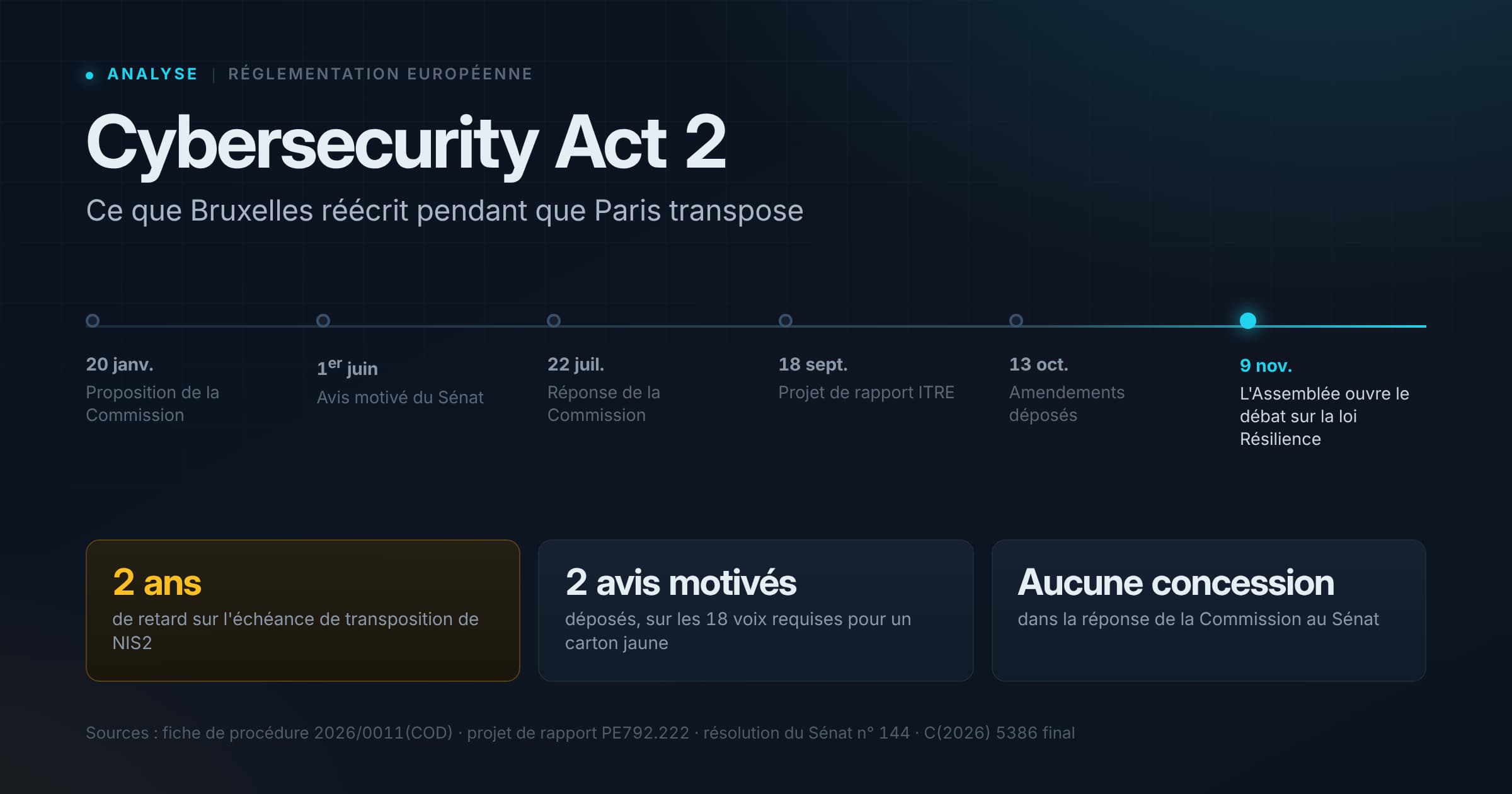
Cybersecurity Act 2: what Brussels is rewriting while Paris transposes
France transposes NIS2 two years late while Brussels prepares its revision. The Senate challenged the package on subsidiarity; the Commission amended nothing.
NIS2: what the directive actually requires, and where France stands
Wider scope, accountable directors, reporting within 24 hours: what NIS2 actually requires, and why France's delay is no reason to wait before preparing.