


N-able switches off N-central: a vendor takes down its own platform
Able2Shell: seven CVEs fixed, then fresh exploit chains claimed against the hotfix. What the N-central affair says about the tools that run other people's IT.
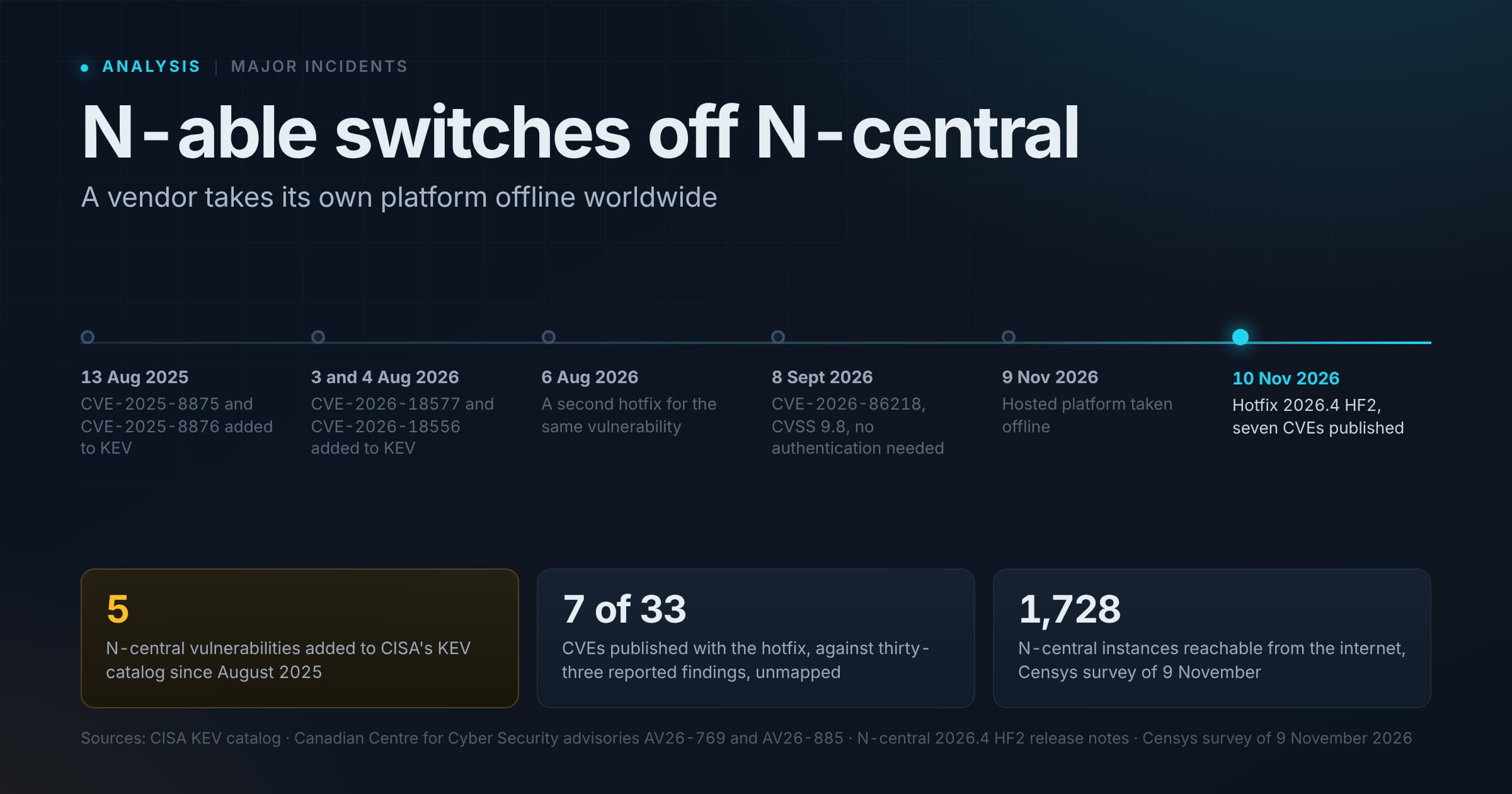
Pulling the plug on your own platform is not a decision a vendor takes twice a year. N-able took it on 9 November 2026: its hosted N-central environment was taken offline across the Americas, Asia-Pacific and Europe, and customers running the product on their own servers were told to shut them down until further notice. The vendor's other services reachable through N-able Login stayed up1.
No intrusion has been reported. What triggered the shutdown was a publication: the day before, independent researcher Sean Bales had posted thirty-three alleged N-central vulnerabilities, each accompanied by a proof-of-concept exploit. The set is called Able2Shell2.
Where the affair stands on 12 November 2026
N-able released hotfix N-central 2026.4 HF2, build 2026.4.1.26, on 10 November 2026, describing it as a critical security update. It covers seven CVEs with CVSS v4 scores between 8.3 and 9.3: two critical flaws, an XML external entity issue and a server-side request forgery, and five high-severity ones ranging from OGNL injection to remote code execution through path traversal3. All hosted instances had finished upgrading by 11 November at 01:04 UTC.
The upgrade does not stop at the server. Agents and probes must be upgraded too, including for hosted customers, and in that order: an upgraded probe no longer communicates with agents that have not been upgraded. The hotfix also removes legacy mobile device management and temporarily disables N-central's built-in remote control; Take Control still works3.
Seven CVEs against thirty-three reported findings, with no published mapping between the two inventories. The gap does not mean twenty-six flaws remain open — one identifier can cover several weaknesses — but the vendor has said neither what each CVE covers nor how many of the thirty-three it was able to reproduce. A follow-up hotfix is announced, with no date3.
Fresh chains claimed despite HF2
On 12 November, Sean Bales published two further sets, 4EverAble2Shell and Agent2Shell, which he presents as working against the patched build 2026.4.1.264.
| 4EverAble2Shell | Agent2Shell | |
|---|---|---|
| Target | The N-central server | Managed Windows agents |
| Researcher's claim | Unauthenticated remote code execution with root privileges | More than ten previously undisclosed flaws allowing commands to run as NT AUTHORITY\SYSTEM, provided the appliance identifier is known |
| Vendor's position | Requires the Legacy API to be enabled and internet-exposed, a configuration disabled by default and not recommended. Hosted environments unaffected. | No public position to date |
| Observations | Probes seen by watchTowr against installations with the Legacy API enabled | No public observation |
The distinction matters for deciding what to do. HF2 remains necessary and does fix seven vulnerabilities; it does not answer the scenario described on 12 November. The advisory N-able published that day asks on-premises customers to disable the Legacy API without waiting4, and watchTowr gives the same advice after observing probes5.
Agent2Shell shifts the problem. A later section explains how a compromised N-central server reaches the machines it manages. This second set claims flaws in the agents themselves, which is not the same mechanism: it no longer runs through taking over the central server. The exact conditions of exploitation, the versions concerned and the real reach of execution as NT AUTHORITY\SYSTEM remain the researcher's claims, confirmed by no public validation to date.
No CVE identifier has been assigned to either set.
A library nobody maintains
One element of the observed attack chain deserves isolating. CVE-2026-90436 affects Apache Axis 1.x: when a SOAP message carries an exceptionName element, the library loads the class so named and, if string data accompanies it, instantiates it before checking that it is in fact a fault. Loading triggers the class's static initialiser, and all of this happens before the service's own handlers run, so authentication at the service level does not prevent it. The flaw was published on 6 November 2026 with Apache as the numbering authority. Its CVSS v3.1 score of 9.8 was not assigned by Apache, which publishes only a textual severity, but by CISA's enrichment programme6.
A fix exists in source, as a commit in the axis-axis1-java repository. What Apache makes clear is that no corrective 1.x release is planned: Axis 1 is end-of-life and the project recommends migrating to another SOAP engine6. An organisation depending on a product that embeds this library therefore has no update to install, only a recompilation to hope for from its supplier. Attempts to exploit the flaw have been observed in a chain aimed at N-central, with no successful compromise documented4.
What this sequence demonstrates
Three states are easily conflated here, and telling them apart changes what an administrator has to do. A hotfix existing does not mean it is installed. A server being patched is not even verifiable by version number, since an upgraded server may keep displaying the old one: confirmation runs through the vendor's guidance3. And an environment showing nothing unusual does not mean it is clean. A hotfix removes no account created, no scheduled task and no code implanted between the 8 November publication and the server being shut down. The research note published on 10 November by the Cloud Security Alliance adds that the proof-of-concept code for the XXE flaw reportedly clears its own execution traces, so an absent log entry is not proof that no exploitation succeeded7.
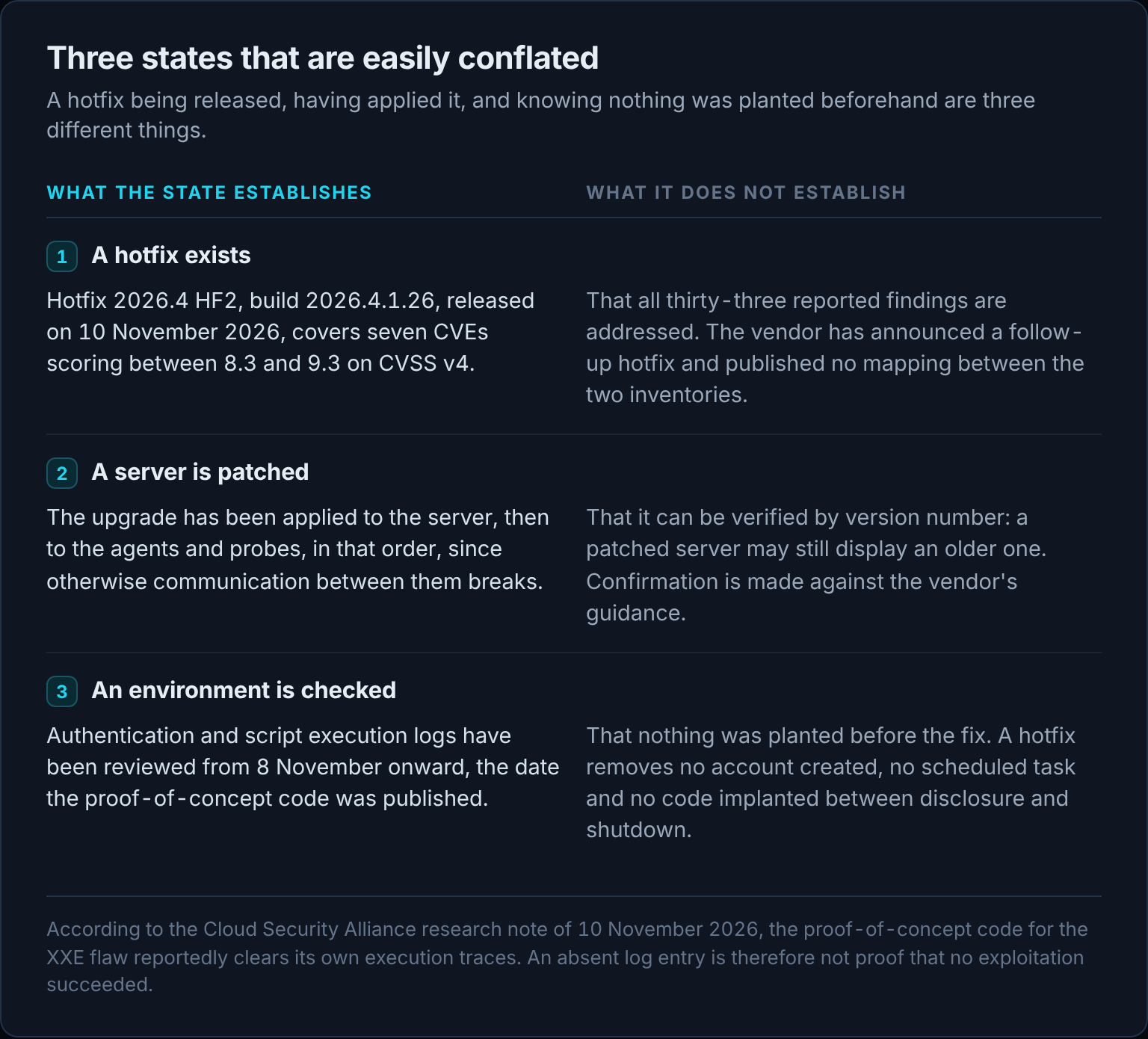
12 November gave that distinction a direct illustration: servers running the latest hotfix remain reachable as soon as an older interface is exposed.
No compromise of any client organisation was publicly confirmed as of 12 November, and none of the seven CVEs appeared in CISA's known exploited vulnerabilities catalog. Censys counted 1,728 N-central instances reachable from the internet on 9 November: that figure measures exposure, not the number of vulnerable servers or affected organisations8.
The disagreement between researcher and vendor hardened in the meantime. Bales defends a method that "makes vendors safer by forcing them to fix problems as fast as possible". N-able's chief executive, John Pagliuca, answers that "publishing exploit code before customers have had the chance to act doesn't make anyone safer"9. Two questions are entangled here without being the same: whether uncoordinated publication raised the immediate risk to customers, and whether the succession of hotfixes reveals an older difficulty in the vendor's vulnerability management. Answering the first does not settle the second.
Why switch off rather than patch
A vendor facing a disclosure normally has several weeks: fix, publish, let customers deploy. That sequence depends on a patch existing, and none did. Work was under way, with no firm release date1.
Two months earlier the vendor had faced a comparable situation and switched nothing off. After CVE-2026-86218 was exploited in September, it applied mitigations directly to every hosted instance and told on-premises customers to install hotfix 2026.3 HF410. The difference lies in what it had to hand: in September, a fix existed.
In November there was nothing to apply, and proof-of-concept code was public for every flaw announced. The gap between a description and a usable exploit is then measured in hours of an attacker's work.
Network filtering remains effective in this situation, and particularly so: a vulnerability exploitable without authentication cannot be exploited by someone who cannot reach the service. What the absence of authentication disqualifies is credential-based control. But N-central is precisely a product that has to stay reachable by the agents it manages and by administration consoles, so that full isolation usually amounts to making it unusable. At that point, switching it off and walling it off look much alike.
The lever covers only part of the estate. On hosted infrastructure the vendor decides. On on-premises installations it can only advise.
What one N-central server commands downstream
N-central belongs to the family of remote monitoring and management tools that IT service providers use to run their clients' estates. Its job is to apply patches and run scripts across thousands of machines without anyone visiting them, which requires an agent on every endpoint holding elevated privileges.
Control of an N-central server therefore lets an attacker borrow the product's administrative functions to reach the managed machines, within the limits of the privileges actually granted, the agents connected and the configuration in place. A single compromise can thus produce effects at several unrelated client organisations. It does not reach all of them automatically.
This is not a theoretical projection. In September 2026, after CVE-2026-86218 was exploited, attackers were observed pushing unauthorised scripts and tools into the managed environments downstream11. The mechanism has already worked on this product, two months before the shutdown.
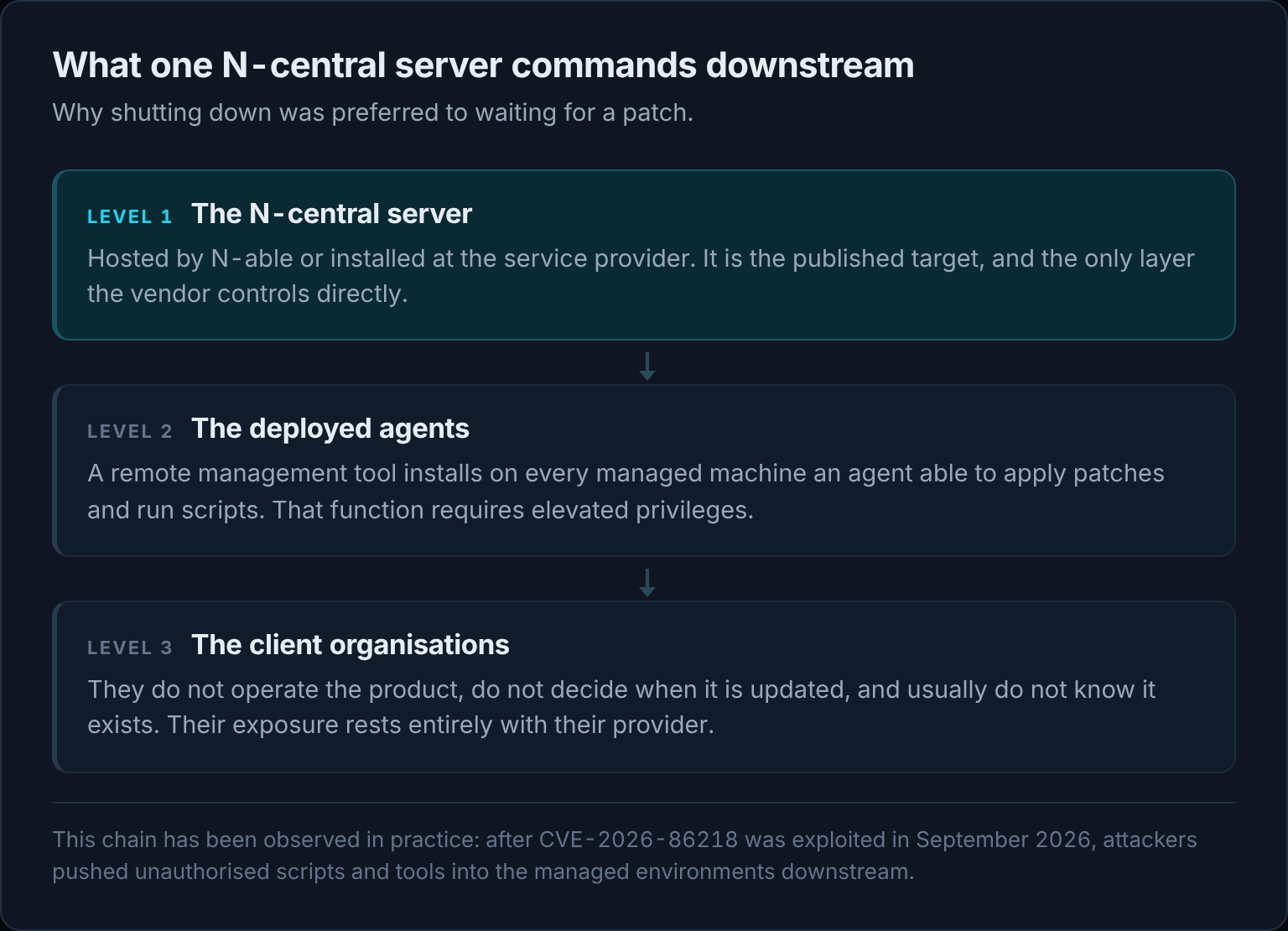
The last level deserves emphasis. A company that buys IT services does not operate N-central, does not decide when it is updated, and usually does not know it exists. Its exposure is settled by contract, not by configuration. That is one reason managed service providers fall within the sectoral scope of NIS2 where they meet the qualifying criteria, and why supply chain security sits among the measures the directive requires.
Five entries in the known exploited vulnerabilities catalog
November's episode would be a curiosity if it stood alone. It does not.
On 13 August 2025, CISA added CVE-2025-8875 and CVE-2025-8876 to its known exploited vulnerabilities catalog — an insecure deserialisation and a command injection, both requiring authentication. N-able said at the time that it had found exploitation in a limited number of on-premises installations, and none in its hosted environment12.
A year later, on 3 and 4 August 2026, two more entries: CVE-2026-18577 and CVE-2026-18556. On 6 August, N-able released a second hotfix, explicitly titled additional mitigation for CVE-2026-1857713. The first had not been enough.
On 8 September 2026, CVE-2026-86218 joined the catalog in turn. CVSS score of 9.8, remote code execution without authentication, exploitation confirmed by the vendor itself1014.
Five entries in thirteen months for a single product, and a hotfix that needed hotfixing.
The researcher's grievance, the vendor's reply
Sean Bales published his work on GitHub and relayed it on LinkedIn, saying he had tested against version 2026.4.0.31 of the N-central appliance. He claims four exploit chains, code execution as root, creation of unauthorised administrative accounts, and leakage of configurations and credentials, and believes earlier versions are affected too, though the range has not been confirmed2.
According to SecurityWeek, he proceeded this way after the vendor was slow to fix defects he had reported in another of its products2. That point needs holding firmly: nothing in the available material establishes that he sent N-able the thirty-three N-central vulnerabilities before publishing them. The grievance concerns the history, not Able2Shell.
N-able calls the episode a "public disclosure and non-responsible communication of critical vulnerabilities in N-central"1. The wording repays close reading: in objecting to the method, the vendor concedes the substance. It does not dispute that what was published are critical vulnerabilities in its product, only the way they were made public.
Both positions hold and do not cancel each other. Publishing thirty-three flaws with their proof-of-concept code at once, with no notice, transfers the risk onto organisations that took part in neither the dispute nor the development of the product, above all the end clients. In the other direction, a vendor that accumulates five entries in CISA's catalog and ships an insufficient hotfix weakens the argument that patience would have sufficed.
What is still to be established
Some of what is circulating about this affair is unverified, and the distinction matters as much here as in the Crédit Mutuel Arkéa case, where what was established had to be separated from what was merely reported.
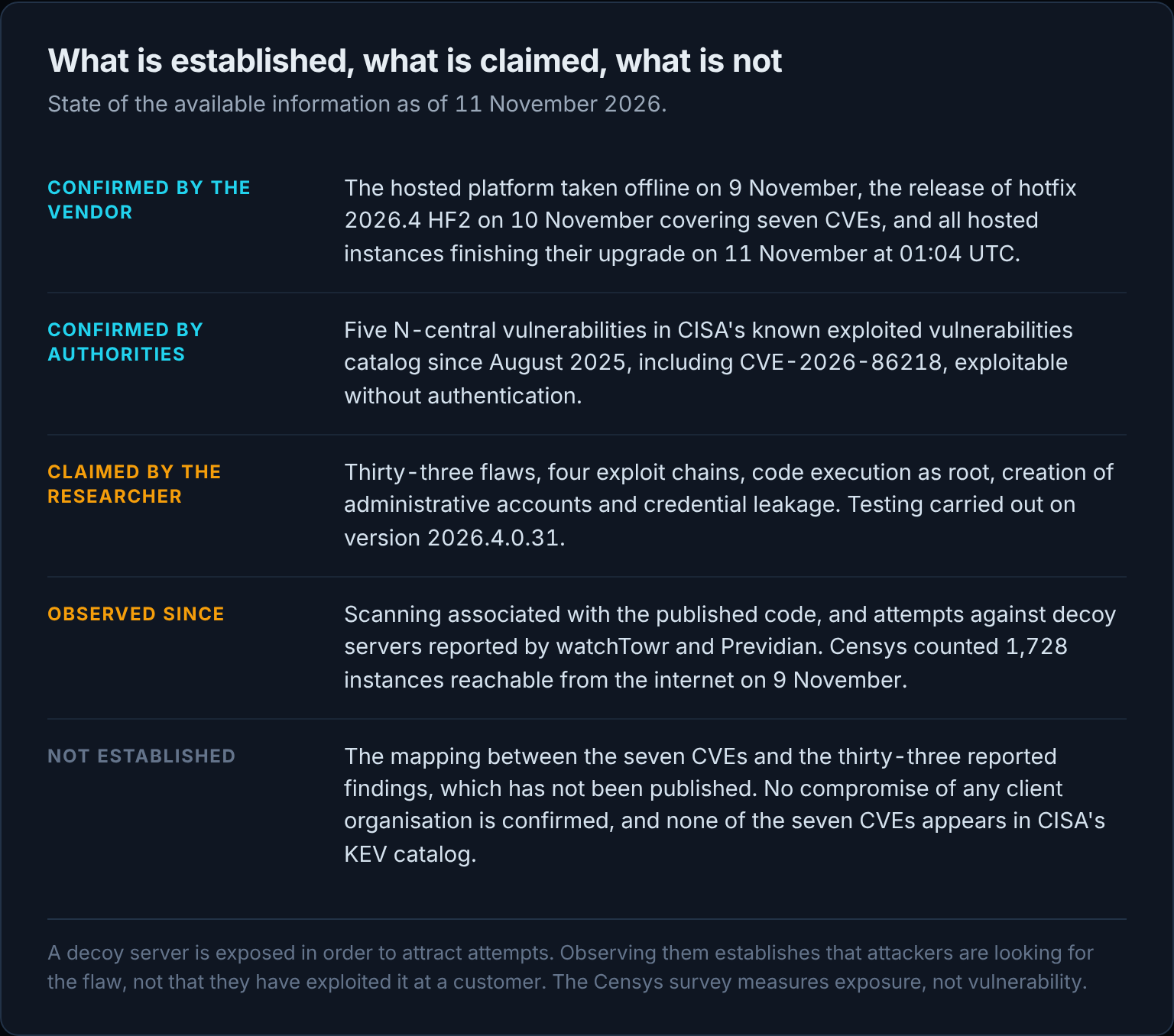
Exploitation attempts have now been reported. Overnight on 9 to 10 November, the firm watchTowr said it had observed attempts against its N-central decoy servers, and advised auditing systems and restricting access15. A decoy server is exposed precisely to attract that kind of traffic: observing attempts establishes that attackers are hunting for the flaw, not that they have exploited it at a customer. The distinction is not a rhetorical precaution; it is the gap between an activated threat and an observed compromise.
Two reservations remain besides. No public reproduction of all thirty-three reported findings has been documented, although Previdian founder Ryan Dewhurst reports that working proof-of-concept code demonstrates a complete chain leading to command execution1. And the figure of "more than 500,000 organisations" that circulated comes from the vendor's promotional material; the Censys survey of 9 November, by contrast, counts 1,728 instances reachable from the internet8.
The attempt counter moves by the hour and is not in itself informative: what matters is the distinction between a decoy being probed and an organisation being compromised, and that second category was still empty on 12 November.
What a client can actually do
For a service provider running N-central, the guidance has changed three times in four days, and now comes down to four points: apply HF2, disable the Legacy API, upgrade agents and then probes, and confirm the installation against the vendor's guidance rather than the version number. Beyond that, examine authentication and script execution logs from 8 November onwards, looking for administrative accounts, scripts and remote access sessions nobody created11.
For a client organisation the room for action is narrower, but it is not nil. Three questions arise in order: does my provider use this product, have they shut it down, and what are they telling me about the checks they have run? A company can also watch its own endpoints for itself — account creations, unexpected script executions — without asking anyone, and confirm that its contract requires it to be told about an incident at its supplier.
An organisation that cannot answer any of those questions has just learned something about its own visibility.
Sources & notes
-
Alissa Irei, "N-able takes N-central platform offline after zero-day dump", TechTarget, 9 November 2026, https://www.techtarget.com/news/n-able-takes-n-central-platform-offline-after-zero-day-dump/874195/ ↩ ↩2 ↩3 ↩4
-
Ionut Arghire, "N-able Takes N-central Offline as Researcher Drops Over 30 Zero-Days", SecurityWeek, 10 November 2026, https://www.securityweek.com/n-able-takes-n-central-offline-as-researcher-drops-over-30-zero-days/ ↩ ↩2 ↩3
-
Tenable, "Able2Shell: Frequently Asked Questions for Reported N-able N-central Zero-Day Vulnerabilities", 11 November 2026, https://www.tenable.com/blog/able2shell-frequently-asked-questions-for-reported-n-able-n-central-zero-day-vulnerabilities ↩ ↩2 ↩3 ↩4
-
The Hacker News, "New N-central Exploits Work Against Patched Servers, Enable Root RCE and Windows SYSTEM Access", 12 November 2026, https://thehackernews.com/2026/11/new-n-central-exploits-work-against.html ↩ ↩2 ↩3
-
watchTowr, post on X, 12 November 2026, https://x.com/watchtowrcyber/status/2120803577094439123 ↩
-
Apache Software Foundation, CVE-2026-90436 record, 6 November 2026, https://app.opencve.io/cve/CVE-2026-90436 ↩ ↩2
-
Cloud Security Alliance, "Able2Shell: N-central Zero-Days and the RMM Kill Switch", research note, 10 November 2026, https://labs.cloudsecurityalliance.org/research/csa-research-note-able2shell-ncentral-zero-days-20261110-csa/ ↩
-
CSO Online, "N-able N-central gets emergency fix two days after 33 exploits published", 10 November 2026, https://www.csoonline.com/article/4247028/n-able-n-central-gets-emergency-fix-two-days-after-33-exploits-published.html ↩ ↩2
-
Infosecurity Magazine, "N-able Rushes Out N-central Fixes After 33 Zero-Days Go Public", 11 November 2026, https://www.infosecurity-magazine.com/news/n-able-n-central-able2shell-0day/ ↩
-
N-able, "URGENT: N-central immediate hotfix required", status dashboard, September 2026, https://uptime.n-able.com/ ↩ ↩2
-
Huntress, "N-able Disables Cloud Services Following Disclosure of Able2Shell Exploit Chains", November 2026, https://www.huntress.com/blog/n-able-disables-cloud-services-following-disclosure-of-able2shell-exploit-chains ↩ ↩2
-
The Hacker News, "CISA Adds Two N-able N-Central Flaws to KEV Catalog", 14 August 2025, https://thehackernews.com/2025/08/cisa-adds-two-n-able-n-central-flaws-to.html ↩
-
Canadian Centre for Cyber Security, "N-able security advisory (AV26-769)", 4 August 2026, updated 7 August 2026, https://cyber.gc.ca/en/alerts-advisories/n-able-security-advisory-av26-769 ↩
-
Cyber Security Agency of Singapore, "Active Exploitation of Vulnerability in N-Able N-Central" (AL-2026-118), 9 September 2026, https://www.csa.gov.sg/alerts-and-advisories/alerts/al-2026-118/ ↩
-
watchTowr, post on X, 10 November 2026, https://x.com/watchtowrcyber/status/2120096657366827381 ↩
Comments (0)
Leave a comment
Have an account? Sign in to comment with your account
No comments yet. Start the conversation!
Read next
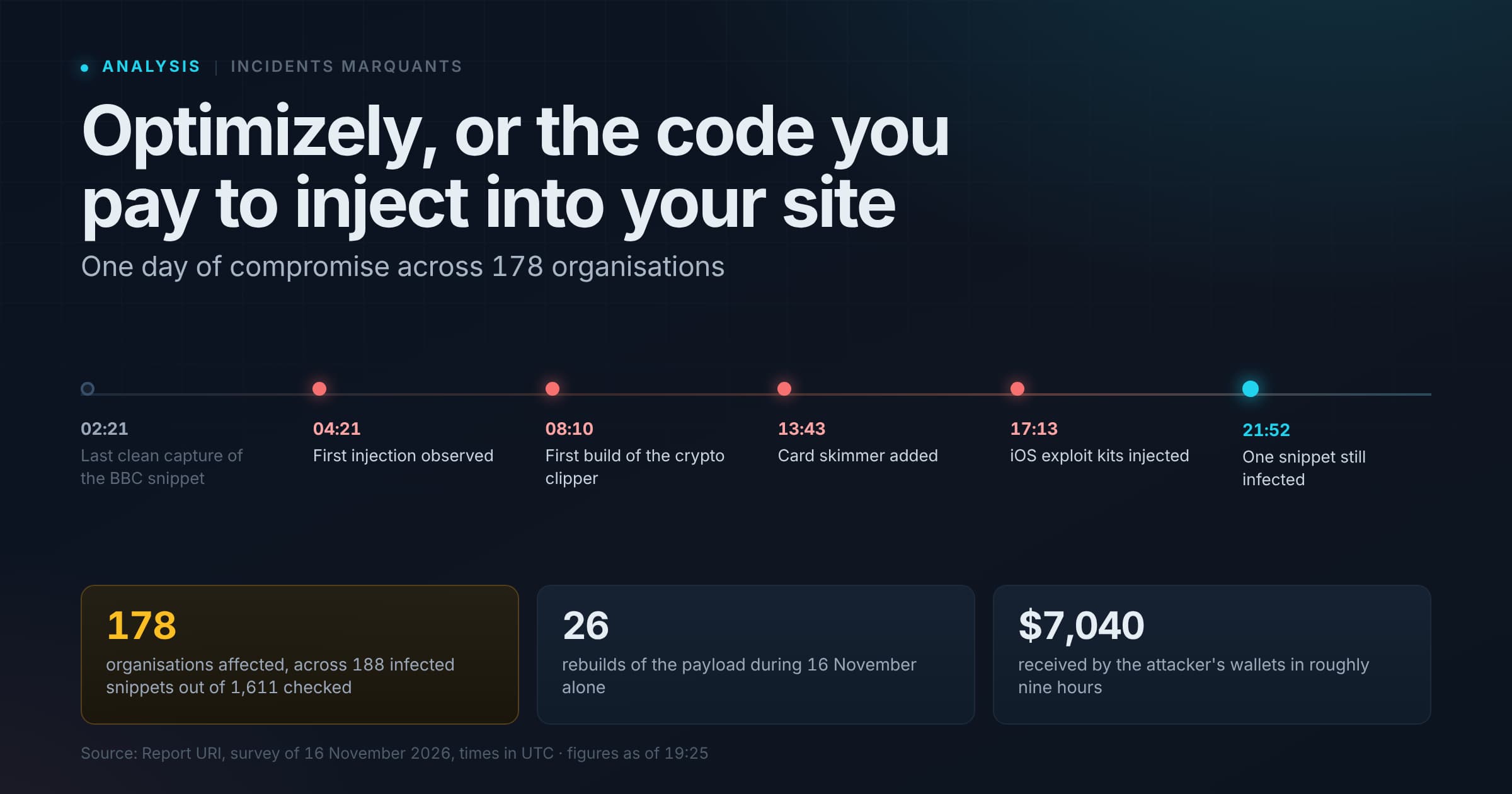
Optimizely: the code you pay to inject into your own site
178 organisations served a card skimmer through Optimizely. The attacker subverted nothing. He used exactly the function the platform exists to provide.
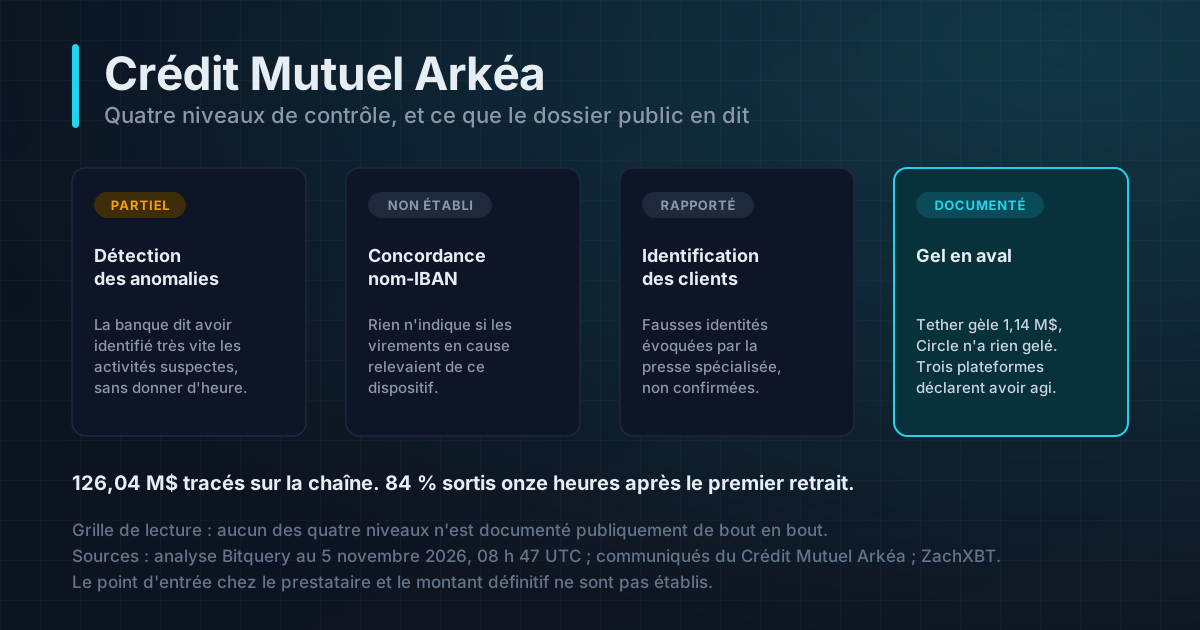
Crédit Mutuel Arkéa: what the controls could see
Four levels of control sit between a bank transfer and its conversion into crypto. In the Crédit Mutuel Arkéa case, only one produced a documented effect.
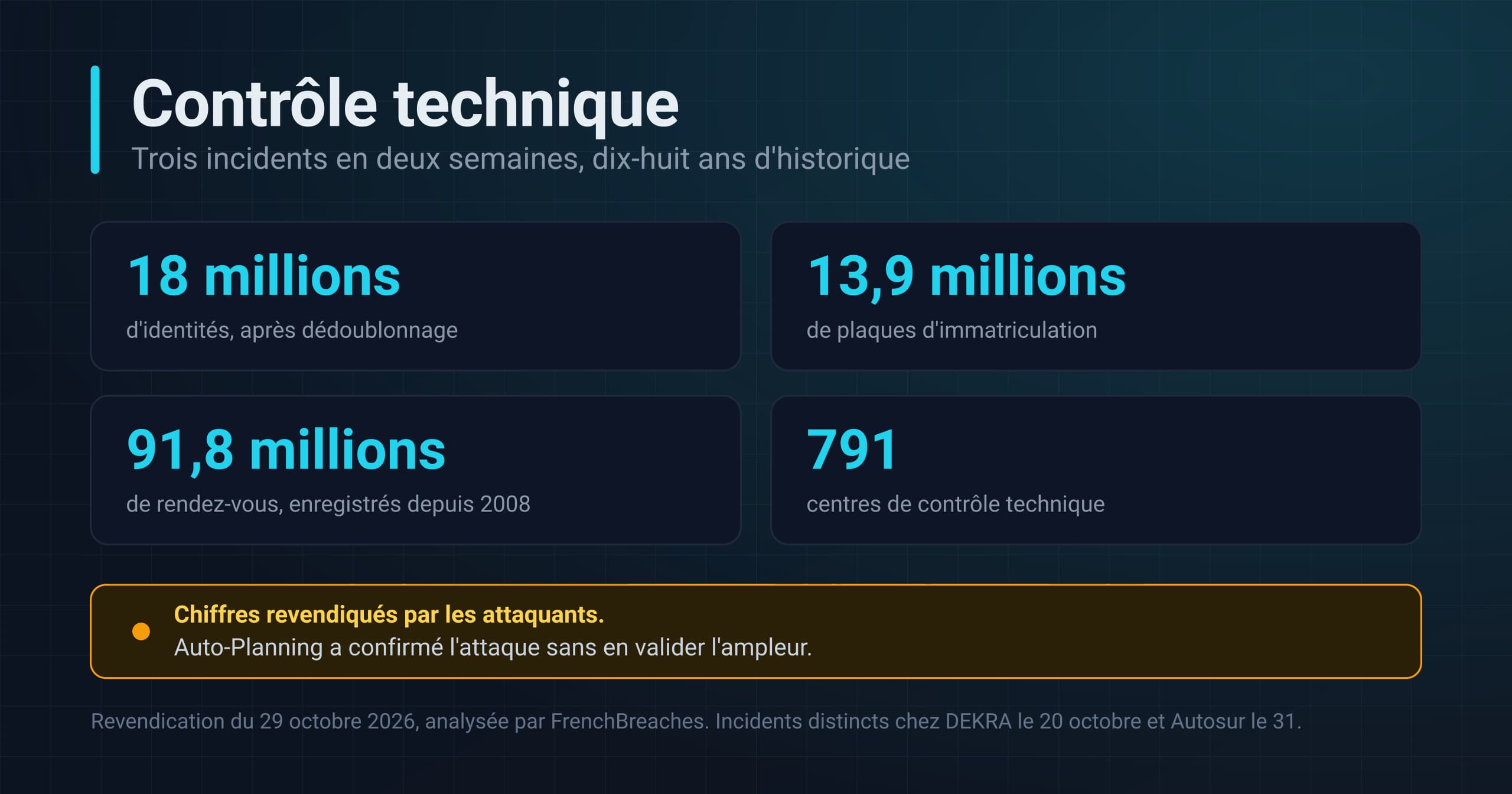
Vehicle inspection data: three incidents in two weeks, eighteen years of records
Three incidents in two weeks at vehicle inspection suppliers, eighteen years of records, and no simple way to find out whether you are among the affected.